18 System of Particles
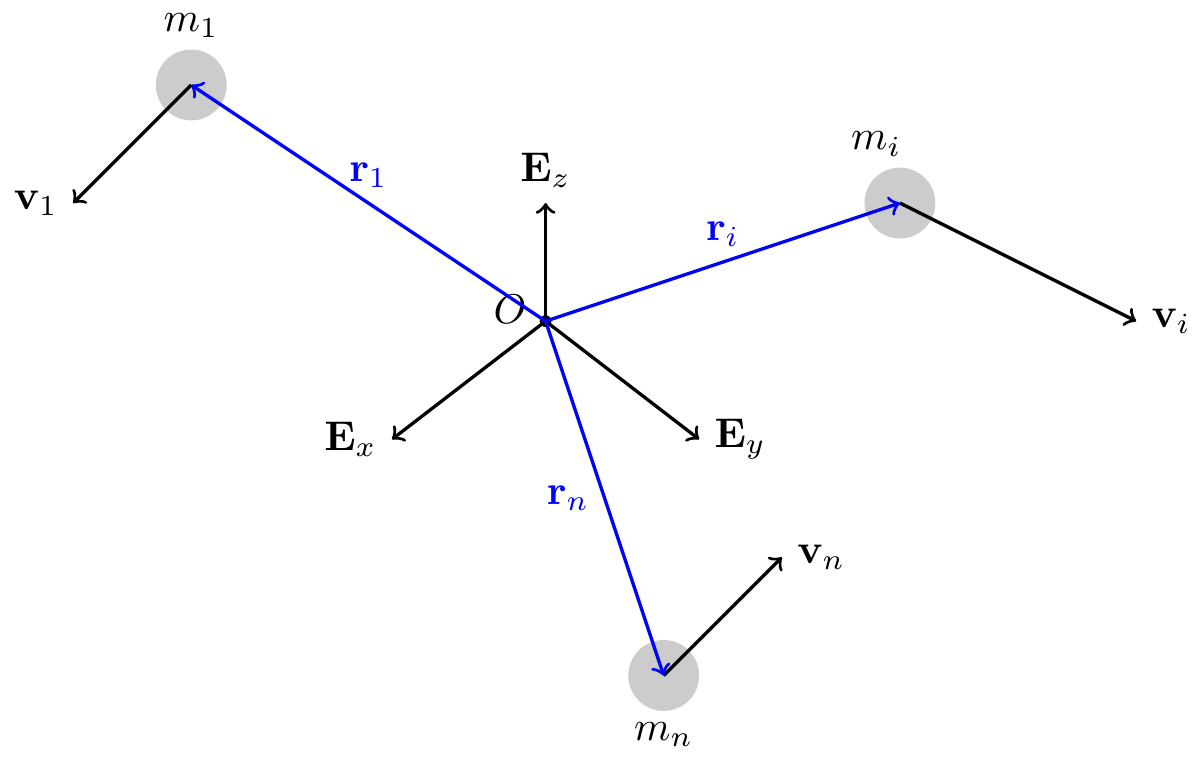
Consider a system of \(n\) particles. A typical particle has mass \(m_i\), position vector \({\bf r}_i\) relative to \(O\), velocity \({\bf v}_i = \dot{\bf r}_i,\) acceleration \({\bf a}_i = \dot{\bf v}_i\), linear momentum \({\bf G}_i = m_i{\bf v}_i,\) angular momentum relative to some point \(P\) \({\bf H}^P_i = ({\bf r}_i-{\bf r}_P)\times{\bf G}_i,\) and kinetic energy \(T_i = \frac{1}{2}m_i{\bf v}_i\cdot{\bf v}_i\).
In this chapter, we define analogous system-level quantities and derive the balance laws for the system from the balance law for each individual particle.
18.1 Center of Mass
TipThink!
Question: What is the position vector of the center of mass of a system of particles?
NoteAnswer
The center of mass \(C\) has position vector \[\begin{align} {\bf r}_C = \frac{1}{m}\sum_{k=1}^n m_k{\bf r}_k, \end{align}\] where \(m = \sum_{k=1}^n m_k\) is the total mass.
WarningExample
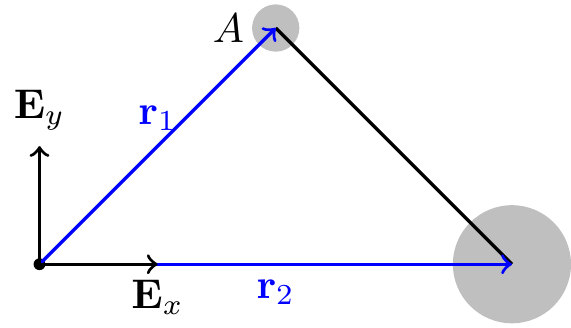
Question: Consider an unsymmetrical dumbbell: particle 1 of mass \(m\) and particle 2 of mass \(3m\) connected by a massless rigid rod, with \[\begin{align*} {\bf r}_1 = {\bf E}_x+{\bf E}_y, \qquad {\bf r}_2 = 2{\bf E}_x. \end{align*}\] Calculate \({\bf r}_C\). Is \(C\) located on the dumbbell?
NoteAnswer
\[\begin{align*} {\bf r}_C = \frac{m{\bf r}_1+3m{\bf r}_2}{m+3m} = \frac{{\bf r}_1+3{\bf r}_2}{4} = \frac{7}{4}{\bf E}_x+\frac{1}{4}{\bf E}_y. \end{align*}\] We can check mathematically that \(C\) lies on the line connecting \(m_1\) and \(m_2\) by calculating the equation of that line and checking at \(C\) belongs to it.
Alternatively, we can define a new basis, \(\{{\bf u},{\bf v}\}\) and calculate the position of \(C\) relative to \(m_1\) on that basis. This should be along \({\bf u}\).
Note the useful identity: relative to any reference point \(A\), \[\begin{align} {\bf r}_{C/A} = \frac{\sum_i m_i{\bf r}_{i/A}}{\sum_i m_i}. \end{align}\]
TipThink!
Question: Show that \(\sum_{k=1}^n m_k({\bf r}_C-{\bf r}_k) = {\bf 0}\) and \(\sum_{k=1}^n m_k({\bf v}_C-{\bf v}_k) = {\bf 0}\).
NoteAnswer
Both follow directly from the definition of the center of mass.
Differentiating the position of the center of mass: \[\begin{align} {\bf v}_C = \frac{1}{m}\sum_{k=1}^n m_k{\bf v}_k = \frac{1}{m}\sum_{k=1}^n{\bf G}_k. \end{align}\] Notice that the velocity of the center of mass is the weighted sum of the velocities of the particles.
TipThink!
Question: Show that \(\sum_{k=1}^nm_k({\bf r}_C-{\bf r}_k) = {\bf 0}\) and \(\sum_{k=1}^nm_k({\bf v}_C-{\bf v}_k) = {\bf 0}\).
NoteAnswer
…
18.2 Linear Momentum
The linear momentum of the system is \[\begin{align} {\bf G} = m\frac{d{\bf r}}{dt} = \sum_{k=1}^n m_k\frac{d{\bf r}_k}{dt} = \sum_{k=1}^n{\bf G}_k. \end{align}\] The linear momentum of the system equals that of its center of mass.
18.3 Angular Momentum
The angular momentum \({\bf H}^P\) of the system of particles relative to a point \(P\), whose position vector relative to \(O\) is \({\bf r}_P\), is the sum of the individual angular momenta: \[\begin{align} {\bf H}^P = \sum_{k=1}^n{\bf H}^{P_K} = \sum_{k=1}^n({\bf r}_k-{\bf r}_P)\times m_k{\bf v}_k = {\bf H}^C+({\bf r}_C-{\bf r}_P)\times{\bf G}, \end{align}\] where \[\begin{align} {\bf H}^C = \sum_{k=1}^n({\bf r}_k-{\bf r}_C)\times m_k{\bf v}_k = \sum_{k=1}^n({\bf r}_k-{\bf r}_C)\times m_k({\bf v}_k-{\bf v}_C). \end{align}\]
TipThink!
Question: Show that \(\sum_{k=1}^n({\bf r}_k-{\bf r}_P)\times m_k{\bf v}_k = {\bf H}^C+({\bf r}_C-{\bf r}_P)\times{\bf G}\).
NoteAnswer
Introduce \({\bf r}_C-{\bf r}_C\) inside the sum and expand.
18.4 Kinetic Energy
The kinetic energy of the system is: \[\begin{align} T = \sum_{k=1}^n\frac{1}{2}m_k{\bf v}_k\cdot{\bf v}_k = \frac{1}{2}m{\bf v}_C\cdot{\bf v}_C+\frac{1}{2}\sum_{k=1}^n m_k({\bf v}_k-{\bf v}_C)\cdot({\bf v}_k-{\bf v}_C). \end{align}\] The kinetic energy splits into the kinetic energy of the center of mass plus the kinetic energy relative to the center of mass. In general, \(T \neq \frac{1}{2}m{\bf v}_C\cdot{\bf v}_C\).
TipThink!
Question: Prove \(\sum_{k=1}^n\frac{1}{2}m_k{\bf v}_k\cdot{\bf v}_k = \frac{1}{2}m{\bf v}_C\cdot{\bf v}_C+\frac{1}{2}\sum_{k=1}^n m_k({\bf v}_k-{\bf v}_C)\cdot({\bf v}_k-{\bf v}_C)\).
NoteAnswer
Add \({\bf v}_C-{\bf v}_C\) to each \({\bf v}_k\), expand, and use \(\sum m_k({\bf v}_k-{\bf v}_C) = {\bf 0}\).
18.5 Kinetics: Balance of Linear Momentum
Starting from \({\bf F}_i = m_i{\bf a}_i\) for each particle and summing: \[\begin{align} {\bf F} = \sum_{k=1}^n{\bf F}_k = m{\bf a}_C. \end{align}\] The resultant external force equals the total mass times the acceleration of the center of mass.
ImportantNote!
The conditions for conservation of linear momentum of a system (completely or along a direction) are analogous to those for a single particle: \({\bf F}\cdot{\bf c} = 0\) for a constant \({\bf c}\).
18.6 Kinetics: Balance of Angular Momentum
Starting from \({\bf H}^P = \sum_{k=1}^n({\bf r}_k-{\bf r}_P)\times m_k{\bf v}_k\), the time derivative is: \[\begin{align} \dot{\bf H}^P = \sum_{k=1}^n({\bf r}_k-{\bf r}_P)\times{\bf F}_k-{\bf v}_P\times{\bf G} = {\bf M}^P-{\bf v}_P\times{\bf G}, \end{align}\] where the resultant moment of the system of forces relative to \(P\) is \({\bf M}^P = \sum_{k=1}^n({\bf r}_k-{\bf r}_P)\times{\bf F}_k\). The angular momentum theorem becomes \[\begin{align} \dot{\bf H}^P = {\bf M}^P-{\bf v}_P\times{\bf G}. \end{align}\]
ImportantNote!
\(\dot{\bf H}^P\) is not necessarily equal to \({\bf M}^P\). The two agree only in special cases.
Two important special cases:
- \(P = O\) (fixed origin, \({\bf v}_O = {\bf 0}\)): \(\dot{\bf H}^O = {\bf M}^O = \sum_{k=1}^n{\bf r}_k\times{\bf F}_k\).
- \(P = C\) (center of mass, \({\bf v}_C\times{\bf G} = {\bf 0}\)): \(\dot{\bf H}^C = {\bf M}^C = \sum_{k=1}^n({\bf r}_k-{\bf r}_C)\times{\bf F}_k\).
ImportantNote!
The conditions for conservation of angular momentum of a system are analogous to those for a single particle.
Example: A pendulum suspended from a cart on smooth horizontal rails — write the BoAM in 3 forms.
18.7 Work-Energy Theorem
The work-energy theorem for a system of particles is: \[\begin{align} \dot{T} = \sum_{k=1}^n{\bf F}_k\cdot{\bf v}_k, \end{align}\] and \[\begin{align} \dot{E} = \sum_{k=1}^n{\bf F}_{nc_k}\cdot{\bf v}_k. \end{align}\] where \({\bf F}_{nc_k}\) is the nonconservative force acting on the \(k\)th particle and \(E\) is the total energy of the system of particles. Integrating: \[\begin{align} T(t_2)-T(t_1) = \sum_{k=1}^n W_{{\bf F}_k,12}, \qquad W_{{\bf F}_k,12} = \int_{t_1}^{t_2}{\bf F}_k\cdot{\bf v}_k\,dt. \end{align}\]
ImportantNote!
The work of a force is the integral of the force dotted with the velocity of the point of application of the force.
WarningExample
Question: Consider the unsymmetrical dumbbell (particle 1 of mass \(m\), particle 2 of mass \(3m\), massless rod) moving in the smooth \(\{{\bf E}_x,{\bf E}_y\}\) plane with gravity along \(-{\bf E}_z\). Is the energy conserved?
NoteAnswer
Drawing the FBDs of both masses: …
18.8 Summary
Kinematics of a system of particles
Consider a system of \(n\) particles each with mass \(m_i\) and with position vector \({\bf r}_i\) from the origin. The total mass of the system of particles is \(m = \sum_{i=1}^n m_i\). The center of mass of the system of particles \(C\) is defined to be located at \[\begin{align} {\bf r}_C = \frac{\sum_{i=1}^n m_i{\bf r}_i}{m}. \end{align}\] The velocity and acceleration of the center of mass are then obtained by differentiation \({\bf r}_C\). \[\begin{align} {\bf v}_C = \frac{\sum_{i=1}^n m_i{\bf v}_i}{m},\quad\text{and}\quad{\bf a}_C = \frac{\sum_{i=1}^n m_i{\bf a}_i}{m}. \end{align}\] The linear momentum of a system of particles is the sum of the linear momenta of its constituents which is also the linear momentum of the center of mass \[\begin{align} {\bf G} = \sum_{i=1}^n{\bf G}_i = m{\bf v}_C. \end{align}\] The angular momentum of a system of particles about point \(P\) is the sum of the angular momenta of its constituents about \(P\) \[\begin{align} {\bf H}^P = \sum_{i=1}^n\lp{\bf r}_i-{\bf r}_P\rp\times m_i{\bf v}_i. \end{align}\] This expression can be rewritten as \[\begin{align} {\bf H}^P = {\bf H} + ({\bf r}-{\bf r}_P)\times {\bf G}. \end{align}\] where the angular momentum \({\bf H}^C\) of the system about the center of mass can be written equivalently as \[\begin{align} {\bf H} = \sum_{i=1}^n({\bf r}_i-{\bf r}_C)\times m_k{\bf v}_i= \sum_{i=1}^n({\bf r}_i-{\bf r}_C)\times m_i({\bf v}_i-{\bf v}_C). \end{align}\] The kinetic energy of the system of particles is the sum of the kinetic energies of its constituents. This is not equal to the \(\frac{1}{2}m{\bf v}_C\cdot{\bf v}_C\). \[\begin{align} T = \sum_{i=1}^nT_i = \sum_{i=1}^n\frac{1}{2}m_i{\bf v}_i\cdot{\bf v}_i = \frac{1}{2}m{\bf v}_C\cdot{\bf v}_C + \frac{1}{2}\sum_{i=1}^nm_k({\bf v}_i-{\bf v}_C)\cdot({\bf v}_i-{\bf v}_C). \end{align}\]
Kinetics of a system of particles
The balance of linear momentum for a system of particles is obtained by adding the balance of linear momenta of the individual particles \({\bf F}_i = m_i{\bf a}_i\) \[\begin{align} {\bf F} = \sum{\bf F}_i = \sum m_i{\bf a}_i = m{\bf a}_c. \end{align}\] Here, \({\bf F}\) is the net external force acting on the system. The balance of angular momentum of a system of particles about any point \(P\) is \[\begin{align} \dot{\bf H}^P = {\bf M}^P-{\bf v}^P\times{\bf G}. \end{align}\] If \(P\) is a fixed point \(O\), then this equation simplifies to \({\bf M}^O=\dot{\bf H}^O\). If \(P\) is the center of mass \(C\), then this equation simplifies to \({\bf M}^C = \dot{\bf H}^C\). The work-energy theorem for a system of particles is the sum of the work-energy theorems of the individual particles \[\begin{align} \sum \dot{T}_i = \sum {\bf F}_i\cdot{\bf v}_i. \end{align}\] Now that different points in the system have different displacements/velocities, it is important to note that the work of a force \(i\) is obtained by dotting \({\bf F}_i\) with the velocity/displacement of its point of application.
18.9 Exercises
The following problems are from Set 14 – System of Particles.
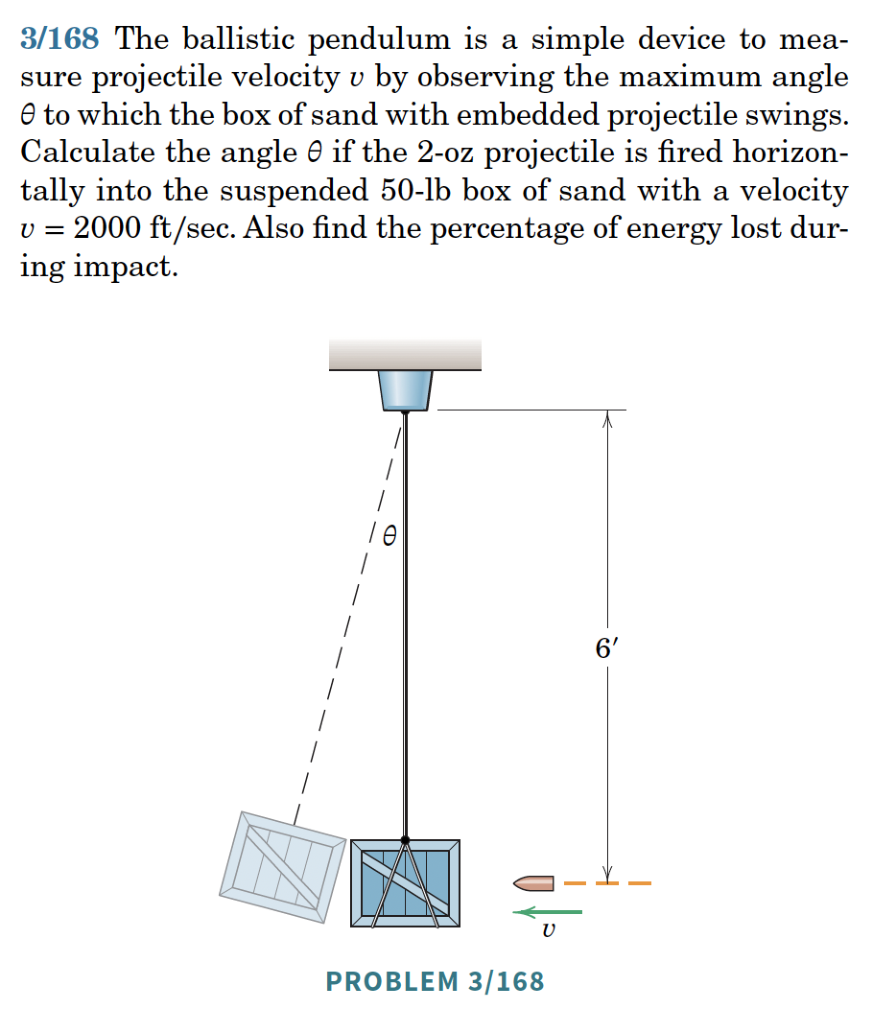
1. [MKB 03-168] Show that during the (very brief) collision, the linear momentum of the bullet–pendulum system is conserved. (ans. \(\theta=20.7^\circ\), \(n=99.8\%\))
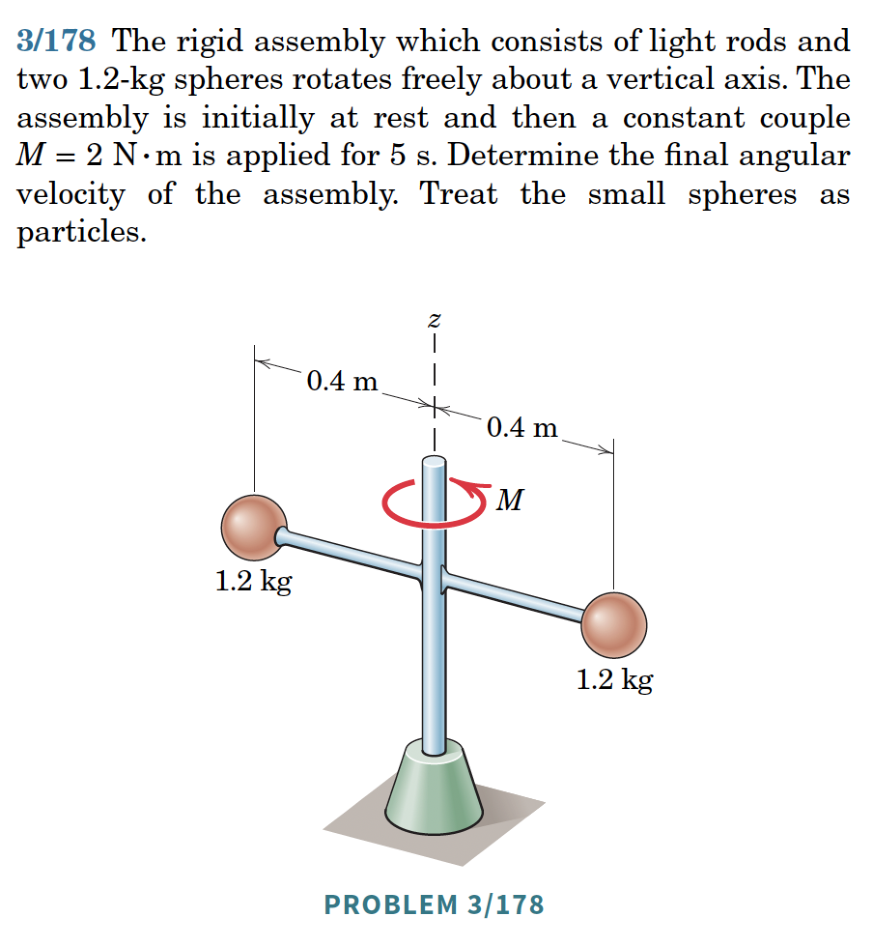
2. [MKB 03-178] Use the integral form of the BoAM; choose the origin at the green base. (ans. \(\dot\theta=26.0\) rad/s)
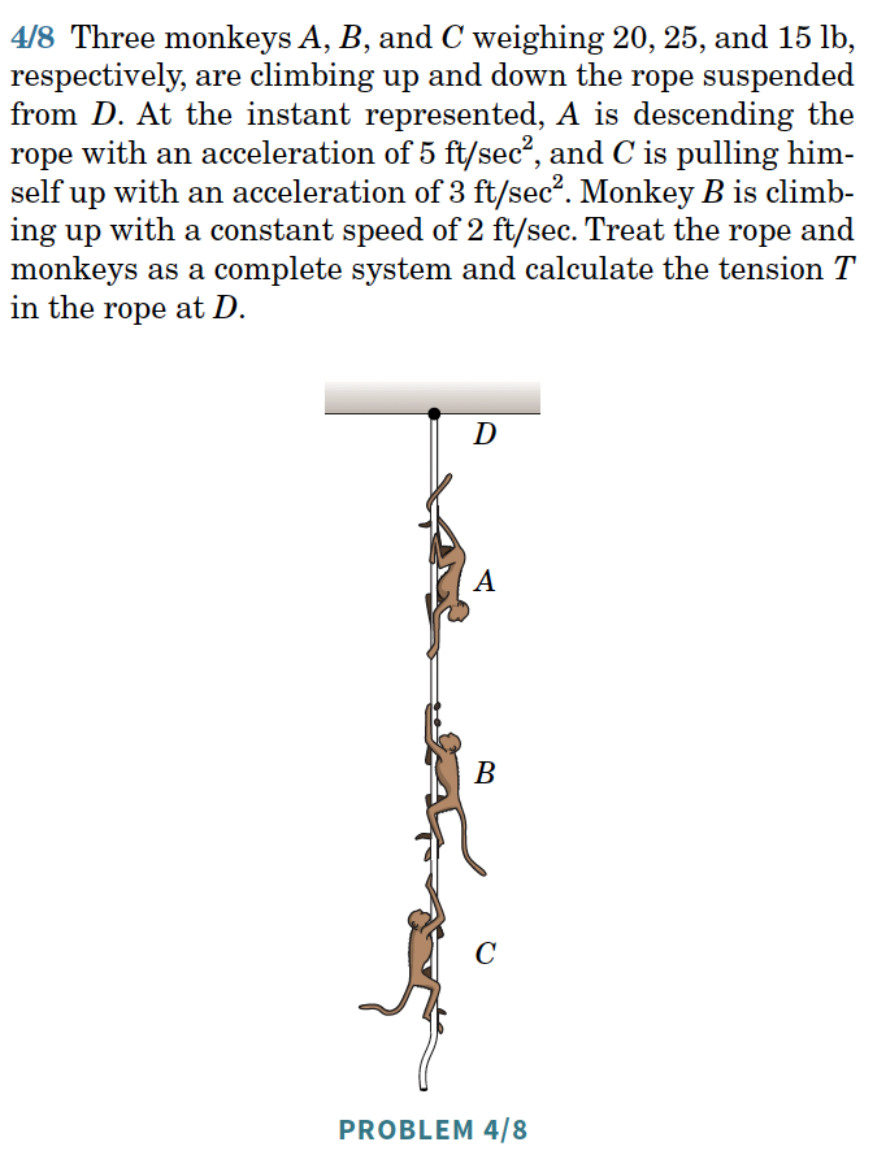
3. [04-008] Take an appropriate cut in the rope. (ans. \(T=58.3\) lb)
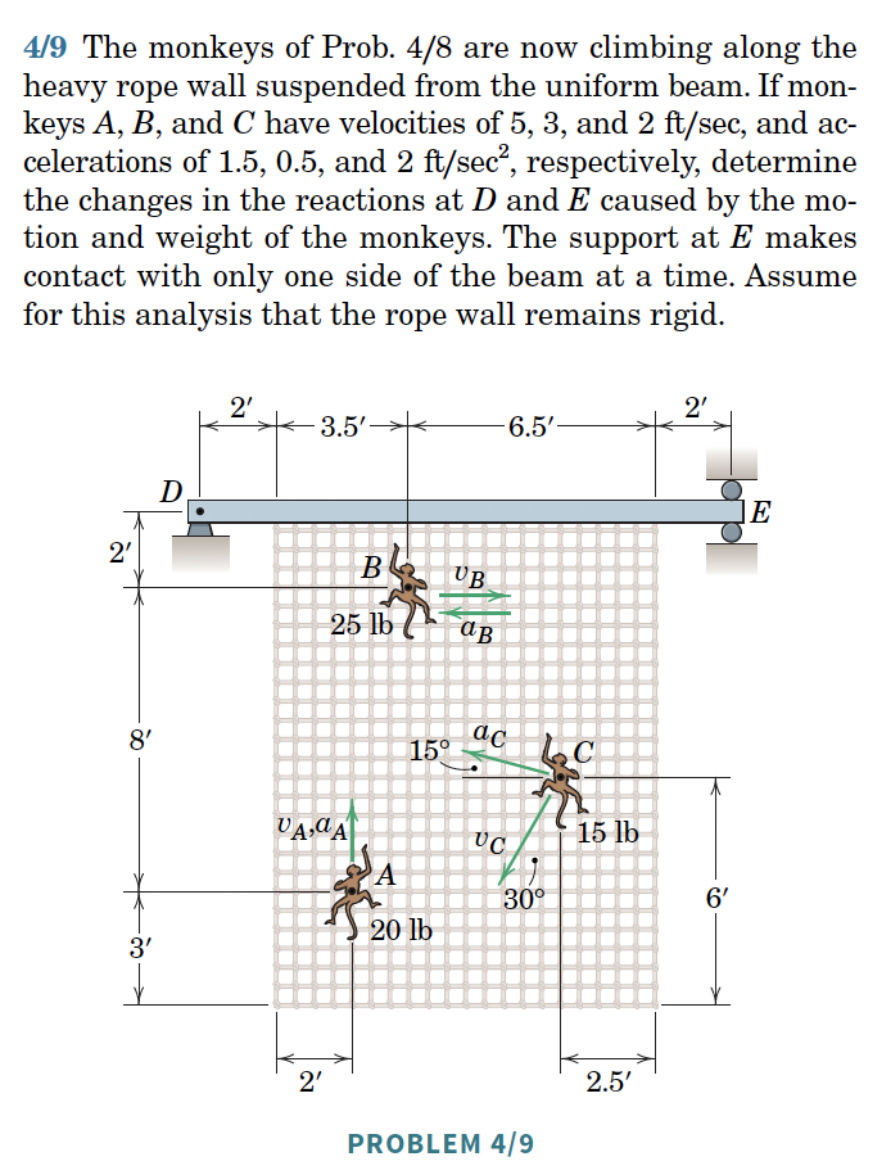
4. [04-009] (ans. \(D_x=1.288\) lb left, \(D_y=35.5\) lb up, \(N_E=25.6\) lb up)
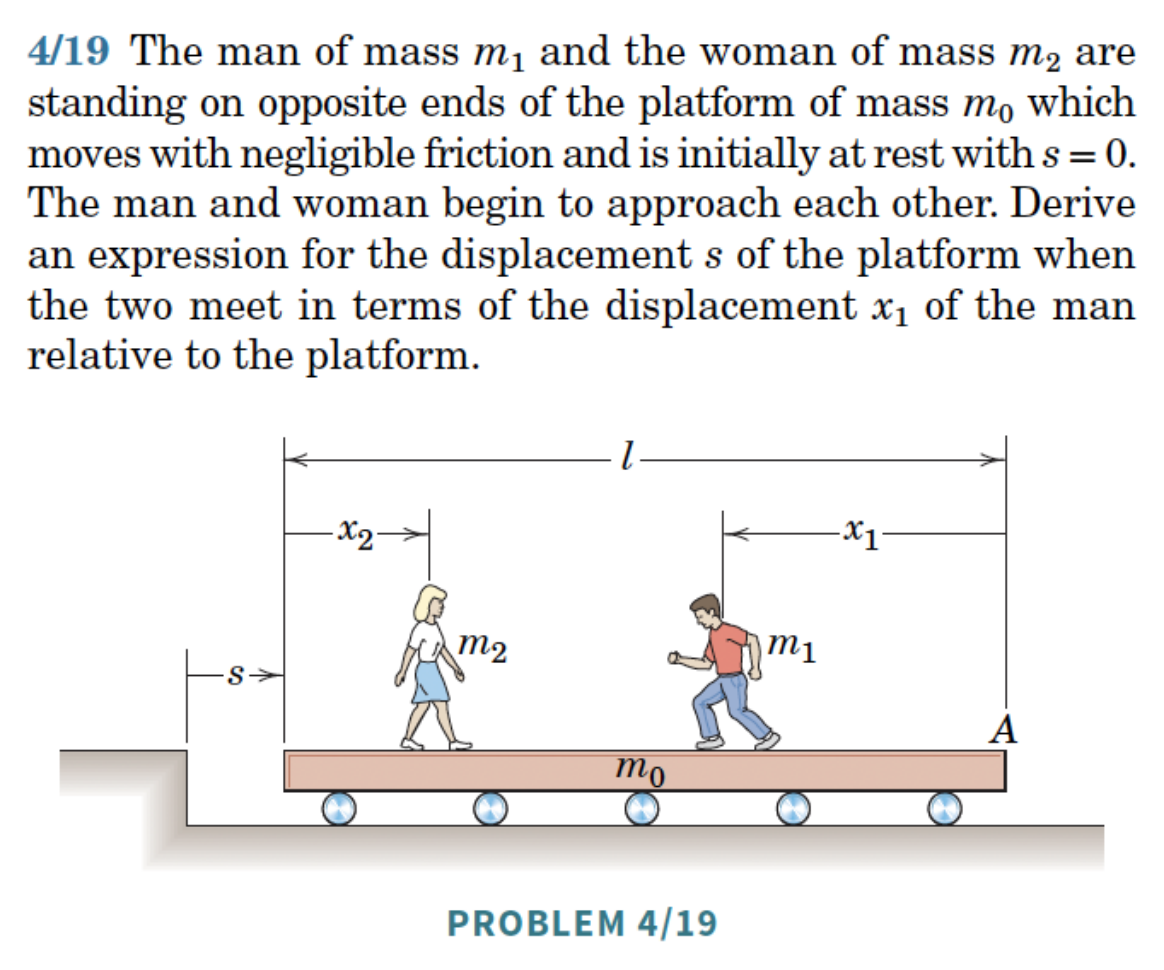
5. [04-019] Identify a direction of linear momentum conservation; the center of mass remains stationary. (ans. \(s=\frac{(m_1+m_2)x_{10}-m_2 l}{m_0+m_1+m_2}\))