14 Gravitational Force Model
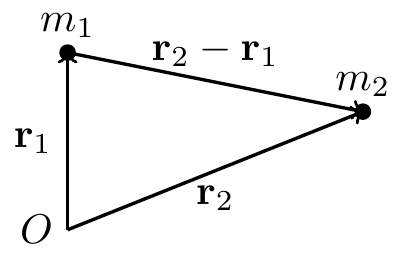
Call \({\bf r}_2 - {\bf r}_1 = {\bf r}_{2/1}\). According to Newton’s law of gravitation, the force on \(m_1\) due to \(m_2\) is: \[\begin{align} {\bf F}_1 = G \frac{m_1 m_2}{\lnorm{\bf r}_{2/1}\rnorm^2}\frac{{\bf r}_{2/1}}{\lnorm{\bf r}_{2/1}\rnorm} = G\frac{m_1 m_2}{\lnorm{\bf r}_{2/1}\rnorm^3}{\bf r}_{2/1}. \end{align}\] where \(G = 6.67408\times10^{-11}\) m\(^3\) kg\(^{-1}\) s\(^{-2}\) is the gravitational constant.
14.1 Example: Attraction Between Earth and an Object of Mass \(m\)
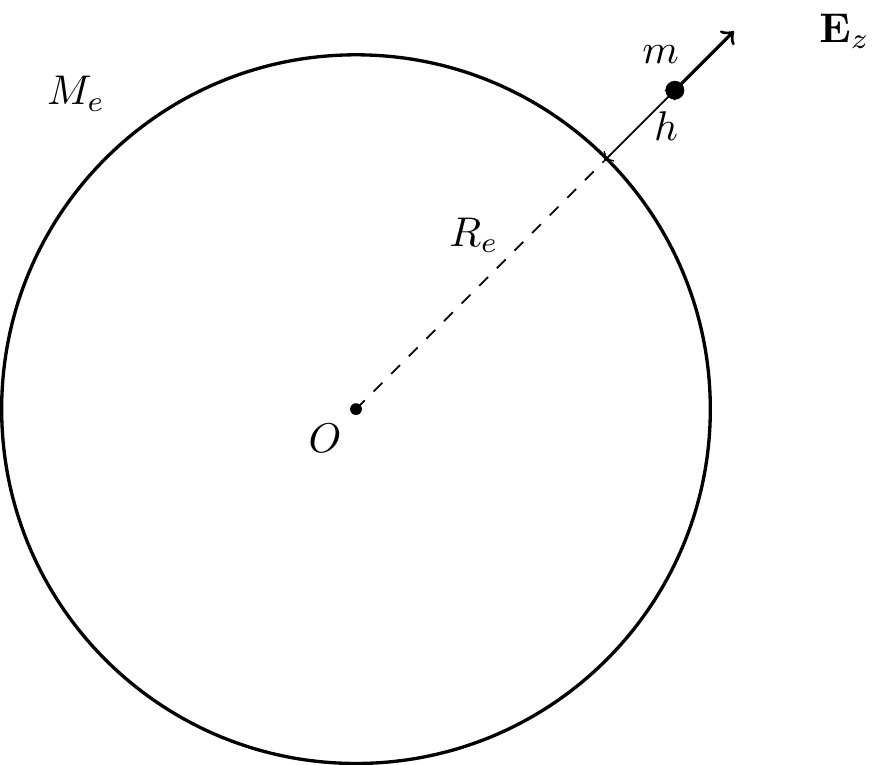
\[\begin{align} {\bf F} = G\frac{M_e m}{\lp R_e+h\rp^2}\lp-{\bf E}_z\rp. \end{align}\]
Since \(h \ll R_e\), we have \(\lp R_e+h\rp^2 \approx R_e^2\), giving: \[\begin{align} {\bf F} = G\frac{M_e}{R_e^2}m\lp-{\bf E}_z\rp = mg\lp-{\bf E}_z\rp, \end{align}\] where \(g = G M_e / R_e^2 = 9.81\) m/s\(^2 = 32.2\) ft/s\(^2\).
Earth’s parameters:
- \(M_e = 5.972 \times 10^{24}\) kg
- \(R_e = 6.371 \times 10^6\) m