12 Spring Force
12.1 Introduction
TipThink!
Question: What does it mean for a spring to be linear?
NoteAnswer
Consider a mass \(m\) suspended by a spring causing an extension \(\delta\). Suspending a mass \(2m\) causes double the extension, \(2\delta\).
Hooke’s Law: The force generated by a spring is assumed to be linearly proportional to its extension/compression.
12.2 The Simple Harmonic Oscillator
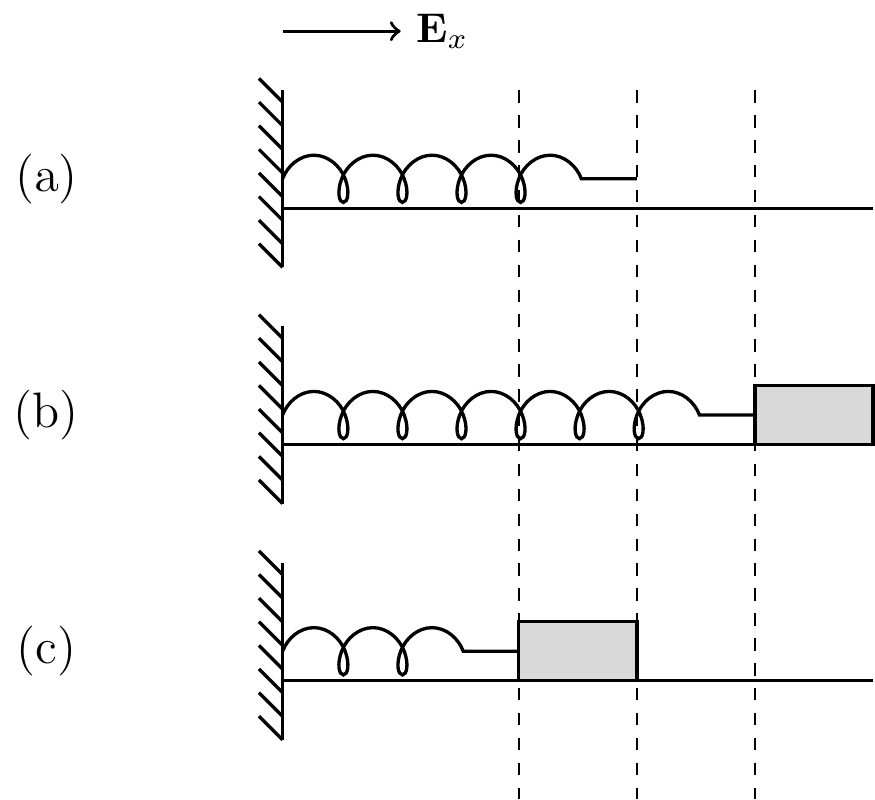
Consider a block of mass \(m\) attached to a linear spring of stiffness \(k\) and unstretched length \(\ell_0\). Denote the current length by \(\ell\) and the stretch by \(\varepsilon = \ell-\ell_0\).
TipThink!
Question: What is the stretch in each case? What is the spring force?
NoteAnswer
Unstretched: Its current length is \(\ell_0\) and its stretch is \(\varepsilon =0\).
Extended: Its current length is \(\ell\) and its stretch is \(\varepsilon = \ell-\ell_0>0\). The spring force is \({\bf F}_s = -k\varepsilon{\bf E}_x\) pointing to the left.
Compressed: Its current length is \(\ell\) and its stretch is \(\varepsilon = \ell-\ell_0<0\). The spring force is \({\bf F}_s = -k\varepsilon{\bf E}_x\) pointing to the right.
ImportantNote! Prescribing the spring force
The spring force always seeks to return the particle to the unstretched state. The same expression applies whether the spring is extended or compressed.
12.3 Formalism
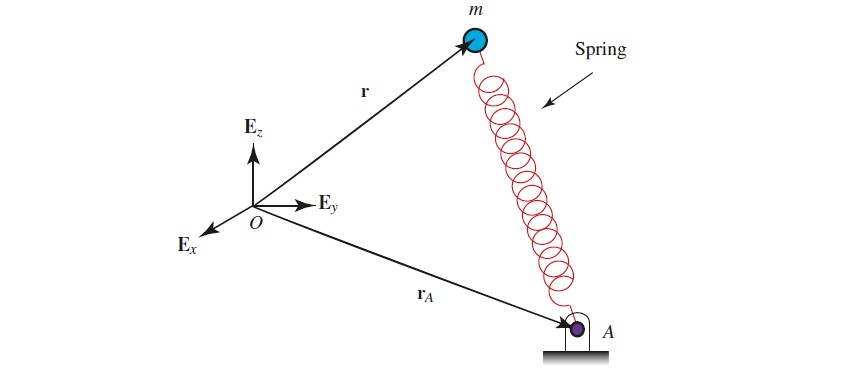
In general:
TipThink!
Question: What is the prescription of the spring force in this general case?
NoteAnswer
…
The stretch is: \[\begin{align} \varepsilon = \lnorm{\bf r}-{\bf r}_A\rnorm-\ell_0, \end{align}\] where \(\ell_0\) is the unstretched length. The magnitude the friction force \({\bf F}_s\) is a statement of Hooke’s law. \[\begin{align} \lnorm{\bf F}_s\rnorm = |K\lp\lnorm{\bf r}-{\bf r}_A\rnorm-\ell_0\rp|. \end{align}\] The spring force is: \[\begin{align} {\bf F}_s = -K\lp\lnorm{\bf r}-{\bf r}_A\rnorm-\ell_0\rp\frac{{\bf r}-{\bf r}_A}{\lnorm{\bf r}-{\bf r}_A\rnorm}. \end{align}\] This direction is correct in both tension and compression.
12.4 Choosing the Origin
12.4.1 Horizontal Simple Harmonic Oscillator
TipThink!
Question: Derive the equations of motion of the harmonic oscillator with the origin at the free end of the spring when it is unstretched.
NoteAnswer
The equation of motion is \[\begin{align} \ddot{x}+\frac{k}{m}x = 0, \end{align}\] where \(x\) is measured from the undeformed position.
TipThink!
Question: Derive the equations of motion with the origin at the fixed end of the spring.
NoteAnswer
…
12.4.2 Vertical Simple Harmonic Oscillator
By analogy, the equation of motion of a vertical harmonic oscillator is: \[\begin{align} \ddot{x}+\frac{k}{m}x = 0, \end{align}\] where \(x\) is measured from the static equilibrium position.
12.5 Summary
The spring force on a mass \(m\) at position \(\mathbf{r}\), attached to a spring (stiffness \(K\), unstretched length \(\ell_0\)) with base at \(\mathbf{r}_A\): \[\begin{align} \mathbf{F}_s = -K(\|\mathbf{r}-\mathbf{r}_A\|-\ell_0)\,\frac{\mathbf{r}-\mathbf{r}_A}{\|\mathbf{r}-\mathbf{r}_A\|}. \end{align}\]
12.6 Exercises
Complete this introduction to vibrations.
The following problems are from Set 09 – Spring Force (Chapter 8 of MKB). In each problem, find the equation of motion of the block.
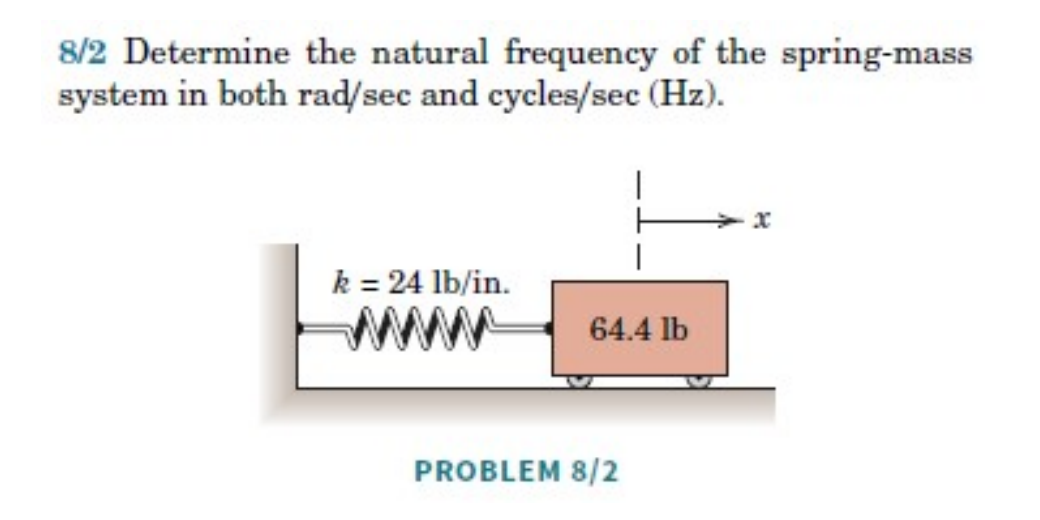
1. [08-002] (ans. \(\omega_n = 12\) rad/s, \(f_n = 1.910\) Hz)
2. [08-004] First determine the static deflection of the spring; take the origin at the statically deflected position. (ans. \(\delta_{st} = 0.200\) m, \(\tau = 0.898\) s, \(v_{\max} = 0.7\) m/s)
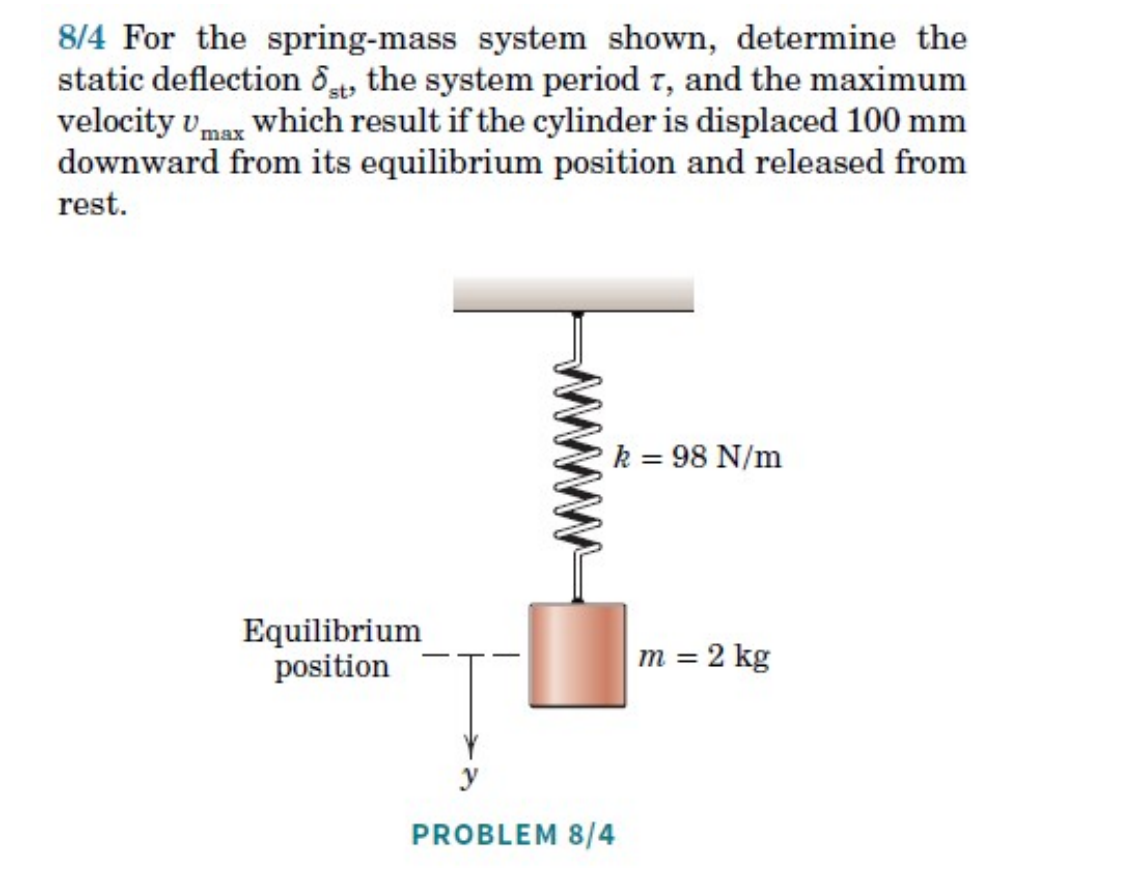
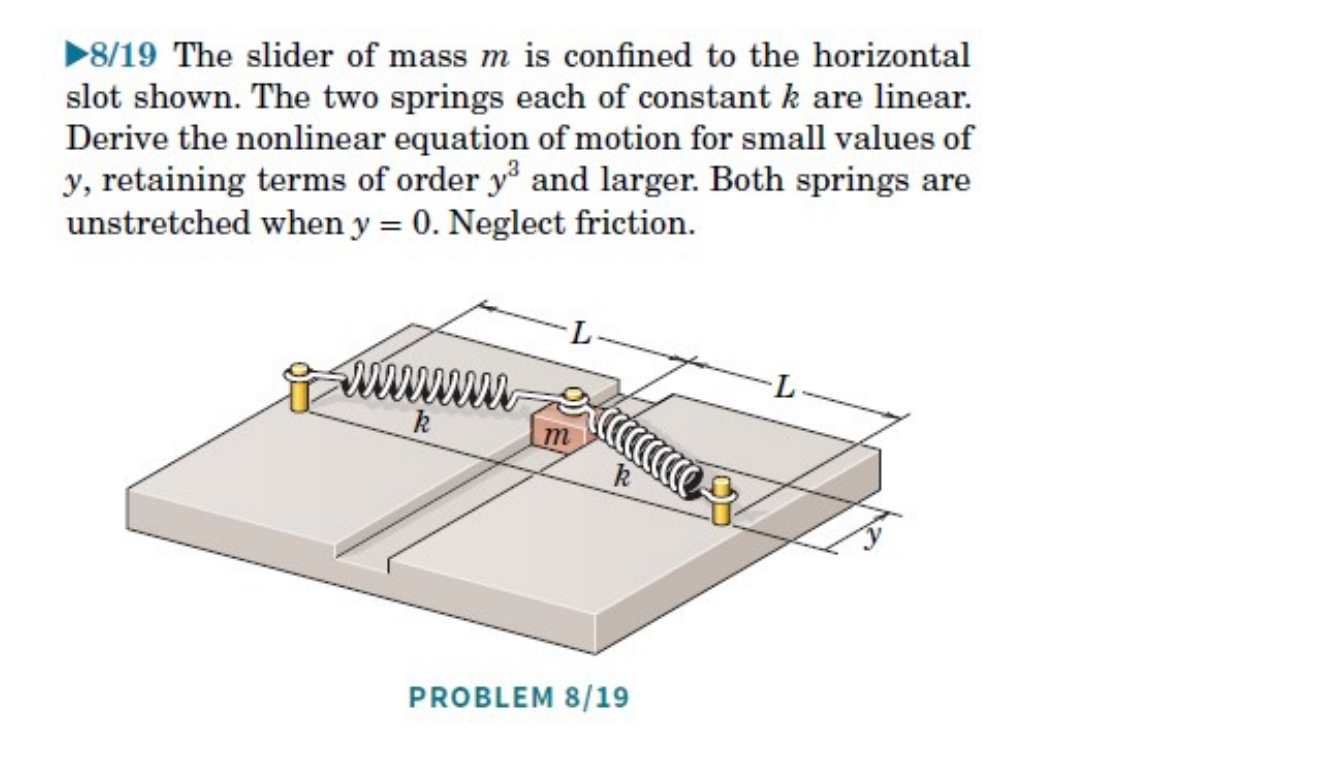
3. [08-019] (ans. \(\ddot y + \frac{3k}{mL^2}y = 0\))