
9 Four Steps to Problem Solving Using the Balance of Linear Momentum
- Specify the system you are considering. Pick a frame (choose an origin and a coordinate system), and express \({\bf r}\), \({\bf v}\) and \({\bf a}\) using that coordinate system.
- Draw a Free Body Diagram (FBD), i.e. model of the forces.
- Write the balance of linear momentum for the system: \({\bf F}=\dot{\bf G}\).
- Do the analysis: project \({\bf F}=\dot{\bf G}\) to get useful equations.
9.1 Example: Projectile Motion
Projectile motion is a curvilinear motion in the plane \(\mathbb{E}^2\).
Choose \(O\) at the launch point, \({\bf E}_x\) along the ground, \({\bf E}_y\) against gravity. \[\begin{align} {\bf r} &= x{\bf E}_x+y{\bf E}_y, \quad {\bf v} = \dot{x}{\bf E}_x+\dot{y}{\bf E}_y, \quad {\bf a} = \ddot{x}{\bf E}_x+\ddot{y}{\bf E}_y. \end{align}\]
Force model:

\[\begin{align} {\bf W} = mg\lp-{\bf E}_y\rp. \end{align}\]
Balance of linear momentum: \[\begin{align} mg(-{\bf E}_y) = m\lp\ddot{x}{\bf E}_x+\ddot{y}{\bf E}_y\rp. \end{align}\] Projecting: \[\begin{align} \lp{\bf F}=\dot{\bf G}\rp\cdot{\bf E}_x &\implies 0 = m\ddot{x} \implies \ddot{x} = 0,\\ \lp{\bf F}=\dot{\bf G}\rp\cdot{\bf E}_y &\implies -mg = m\ddot{y} \implies \ddot{y} = -g. \end{align}\]
Integrating: \[\begin{align} \dot{x}(t) &= \dot{x}_0, \quad x(t) = \dot{x}_0 t,\\ \dot{y}(t) &= -gt+\dot{y}_0, \quad y(t) = -\frac{g}{2}t^2+\dot{y}_0 t+y_0. \end{align}\]
Remark: You can also project \({\bf F} = m{\bf a}\) in the \({\bf E}_z\) direction, but since there are no forces in that direction and the initial velocity in that direction is 0, you conclude that the motion is planar.
9.2 Example: Projectile Motion with Viscous Drag
(Primer Section 1.5.3)
Same kinematics as above.
Force model — weight and Stokes drag:
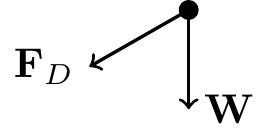
\[\begin{align} {\bf W} &= mg(-{\bf E}_y),\\ {\bf F}_D &= -c_s{\bf v}. \end{align}\] The Stokes drag (1851) applies at low speeds in viscous fluids.
Balance of linear momentum: \[\begin{align} -mg{\bf E}_y -c_s\lp\dot{x}{\bf E}_x+\dot{y}{\bf E}_y\rp &= m\lp\ddot{x}{\bf E}_x+\ddot{y}{\bf E}_y\rp. \end{align}\] Projecting: \[\begin{align} -c_s\dot{x} &= m\ddot{x},\\ -mg-c_s\dot{y} &= m\ddot{y}. \end{align}\] Given initial conditions \(x_0, \dot{x}_0, y_0, \dot{y}_0\), these are an initial value problem (IVP).
Solving the \(x\)-equation (let \(v_x = \dot{x}\)): \[\begin{align} v_x = v_{x_0}e^{-c_s t/m}, \quad \lim_{t\rightarrow\infty} v_x = 0. \end{align}\] Thus, the terminal velocity is only along \({\bf E}_y\).
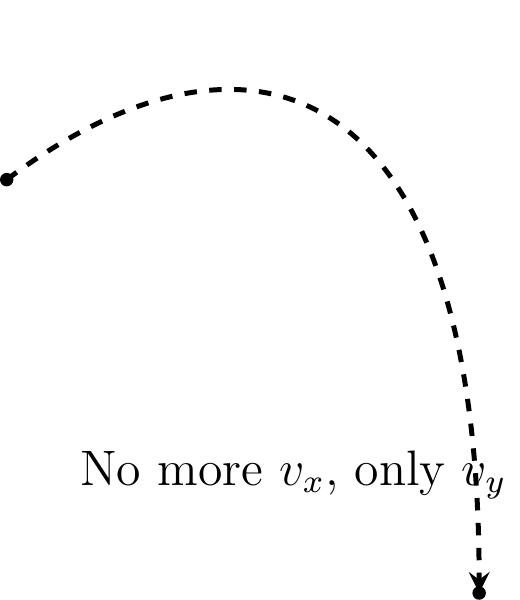
Solving the \(y\)-equation: \[\begin{align} v_y = -\frac{mg}{c_s}+\frac{1}{c_s}\lp mg+c_s v_{y_0}\rp e^{-c_s t/m}. \end{align}\] The terminal velocity: \({\bf v}_{\text{term}} = \frac{mg}{c_s}\lp-{\bf E}_y\rp\).
9.3 Example: Projectile Motion with Bluff Body Pressure Drag
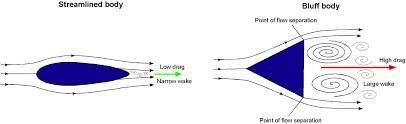
\[\begin{align} {\bf F}_D = \frac{1}{2}m C_D v^2\lp-\frac{\bf v}{\lnorm{\bf v}\rnorm}\rp, \end{align}\] where \(C_D\) is the drag coefficient, \(\rho\) is the density of the fluid, and \(A\) is the projected area in the direction of motion.
See Section 1.6 in the book for a worked example.
9.4 Summary
Balance of linear momentum (BoLM / Newton’s 2nd law / Euler’s 1st law): \[\begin{align} \mathbf{F} = \dot{\mathbf{G}} = m\mathbf{a}. \end{align}\]
The four steps:
- Choose an origin; draw basis vectors; write and differentiate the position vector \(\mathbf{r}\).
- Draw the free body diagram; write expressions for all forces.
- Write the vector BoLM equation \(\sum\mathbf{F} = m\mathbf{a}\).
- Project along chosen directions and analyse to answer the question.
9.5 Lecture Videos
9.6 Exercises
The following problems are from Set 04 – Balance of Linear Momentum.
1. [MKB 2/75] Take \(\mathbf{E}_x\) along the incline and \(\mathbf{E}_y\) perpendicular to it (upwards); origin at \(A\). Follow the 4 steps. (ans. \(\theta = (90^\circ + \alpha)/2\))
2. [MKB 3/004] Consider the whole truck system; follow the 4 steps to find the truck’s acceleration, then isolate a trailer to find the drawbar tension. (ans. \(T = 13.33\) kN, \(a = 0.667\) m/s\(^2\))
3. [MKB 3/005] For each part, determine your system and follow the 4 steps. (ans. \(R = 846\) N, \(L = 110.4\) N)
4. [MKB 3/006] Follow the four steps. (ans. \(F = 2890\) N)
5. [OOR Exercise 1.3] (See O’Reilly Primer for problem statement.)
6. [OOR Exercise 1.5]
7. [OOR Exercise 1.8]