7 Particle Kinematics
7.1 Position, Velocity, and Acceleration
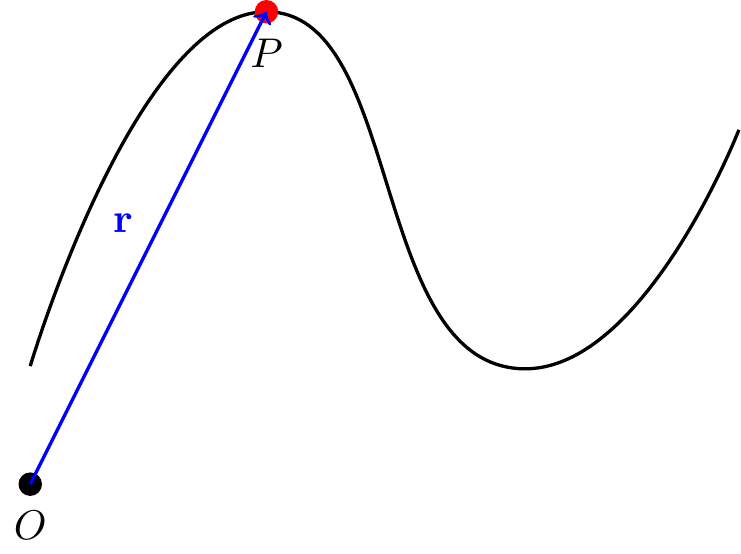
Consider a particle moving in \(\mathbb{E}^3\). Its position vector relative to a fixed origin \(O\) is denoted by \({\bf r} \in \mathbb{E}^3\). As time \(t\) evolves, so does \({\bf r}(t)\).
Let \(\Delta t\) be a finite time elapsed: \[\begin{align} \Delta{\bf r} = {\bf r}(t+\Delta t)-{\bf r}(t). \end{align}\] As \(\Delta t \rightarrow 0\), \(\Delta t\) becomes \(dt\) and \(\Delta {\bf r}\) becomes \(d{\bf r}\). The ‘\(d\)’ means differential. We denote the time derivative of \({\bf r}\) by \(\dot{\bf r}\) or \(\frac{d{\bf r}}{dt}\).
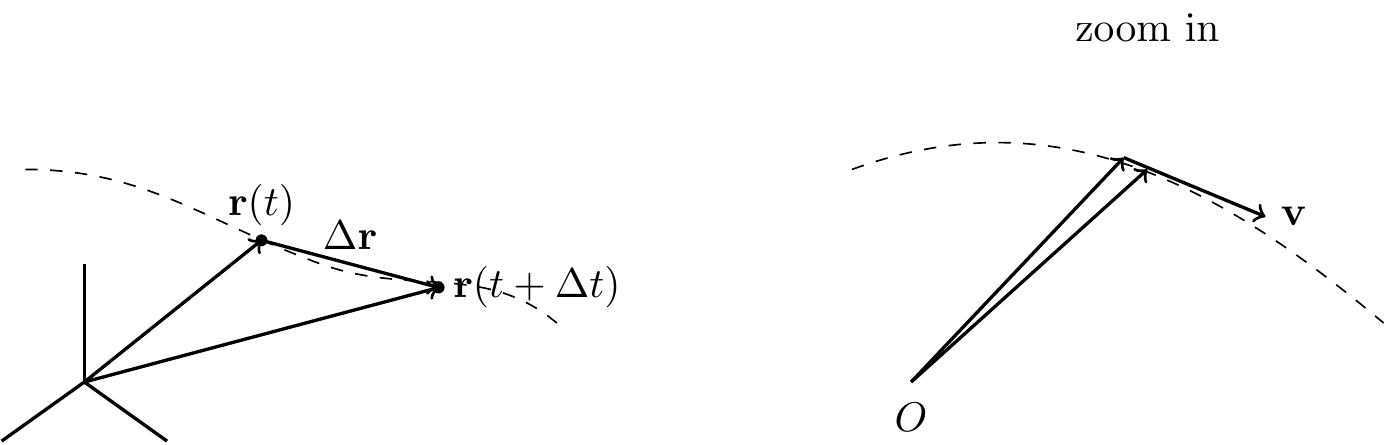
The (absolute) velocity vector \({\bf v}\) of the particle is the time rate of change of the position vector: \[\begin{align} {\bf v} = \frac{d{\bf r}}{dt}=\dot{\bf r} = \lim_{\Delta t \rightarrow 0}\frac{{\bf r}(t+\Delta t)-{\bf r}(t)}{\Delta t}. \end{align}\]
TipThink!
Question: What is the direction of the velocity vector?
NoteAnswer
\({\bf v}\) is along \(d{\bf r}\) which is always tangent to the path.
The speed of the particle is the magnitude of the velocity vector \(v = \lnorm{\bf v}\rnorm\).
The (absolute) acceleration is \[\begin{align} {\bf a} = \frac{d{\bf v}}{dt} = \dot{\bf v} = \ddot{\bf r} = \frac{d^2{\bf r}}{dt^2}. \end{align}\]
7.2 Arc-Length and the Unit Tangent Vector
Define the arc-length parameter \(s\) such that \[\begin{align} \frac{ds}{dt} = \lnorm {\bf v}\rnorm. \end{align}\]
\(\frac{ds}{dt}\) is the speed of the particle. Recall that \({\bf v} = \frac{d{\bf r}}{dt}\), so \[\begin{align} \frac{ds}{dt} = \lnorm\frac{d{\bf r}}{dt}\rnorm. \end{align}\]
So \(ds\) is the length of the differential \(d{\bf r}\) along the curve. Integrating: \[\begin{align} s(t)-s_0 = \int_{t_0}^t\frac{ds}{dt}(\tau)d\tau = \int_{t_0}^t\sqrt{{\bf v}(\tau)\cdot{\bf v}(\tau)}\,d\tau. \end{align}\]
Notes:
- \(s(t)-s_0\) is the distance traveled by the particle along its path \(\mathcal{C}\) during the time interval \([t_0, t]\).
- \(s(t_0)=s_0\) where \(t_0\) and \(s_0\) are initial conditions.
- The dummy variable \(\tau\) is used (as opposed to \(t\)) when evaluating this integral because we are integrating the speed as it varies between \(t_0\) and \(t\). The variable of integration is different than the upper limit of integration.
TipThink!
Question: Under what conditions is \(s(t)\) invertible so that \(t(s)\) is well defined?
NoteAnswer
If the function \(s(t)\) is one-to-one, it can be inverted, and time can be written in terms of arc-length \(t = t(s)\).
TipThink!
Question: Why is \[\begin{align} s(t)-s_0 \neq \lnorm {\bf r}(t)-{\bf r}_0\rnorm? \end{align}\] Under what conditions does the equality hold?
NoteAnswer
The equality holds under rectilinear motion or over an infinitesimal time interval.
We define the unit tangent vector \({\bf e}_t\): \[\begin{align} \frac{\bf v}{\lnorm{\bf v}\rnorm} = {\bf e}_t, \qquad {\bf v} = \frac{d{\bf r}}{dt} = \frac{d{\bf r}}{ds}\frac{ds}{dt} = \dot{s}{\bf e}_t. \end{align}\]
TipThink!
Question: Verify that \({\bf e}_t\) is a unit vector.
NoteAnswer
…
Note the relationships \[\begin{align*} {\bf v} &= \frac{d{\bf r}(t)}{dt} = \frac{d{\bf r}}{ds}\frac{ds}{dt},\\ {\bf a} &= \frac{d{\bf v}(t)}{dt} = \frac{d^2{\bf r}}{ds^2}\lp\frac{ds}{dt}\rp^2+\frac{d{\bf r}}{ds}\frac{d^2 s}{dt^2}. \end{align*}\]
Notice: the acceleration vector is due to changes in both the magnitude and direction of the velocity vector.
TipThink!
Question: Is the unit vector \({\bf e}_t\) constant in general? Under what conditions is it constant?
NoteAnswer
No. It is constant only during rectilinear motion in a fixed direction.
7.2.1 Example
WarningExample
Question: Consider a particle moving in space with position vector \[\begin{align} {\bf r}(t) = R_0\lp\cos(\omega t){\bf E}_x+\sin(\omega t){\bf E}_y\rp. \end{align}\]
Calculate \({\bf v}\), \({\bf a}\), \({\bf v}\times {\bf a}\), \(\lnorm{\bf r}\rnorm\). Describe the motion of the particle. Show that the motion satisfies: \[\begin{align} \ddot{x}+\omega^2 x=0, \qquad \ddot{y}+\omega^2 y=0. \end{align}\]
NoteAnswer
We calculate the velocity and acceleration vectors of the particle as follows:
\[\begin{align*} {\bf v} &= \frac{d{\bf r}}{dt} = R_0\omega\left(-\sin(\omega t)\,{\bf E}_x+\cos(\omega t)\,{\bf E}_y\right),\\ {\bf a} &= \frac{d{\bf v}}{dt} = -R_0\omega^2\left(\cos(\omega t)\,{\bf E}_x+\sin(\omega t)\,{\bf E}_y\right). \end{align*}\]
As you take these derivatives, remember that:
- \(\dot{\bf E}_x={\bf 0}\) and \(\dot{\bf E}_y={\bf 0}\) since the basis \(\{{\bf E}_x,{\bf E}_y\}\) is fixed.
- The chain rule: \(\frac{d}{dx}f(g(x)) = f'(g(x))g'(x).\)
Then,
\[\begin{align*} {\bf r}\times{\bf a} &= R_0\left(\cos(\omega t){\bf E}_x+\sin(\omega t){\bf E}_y\right) \times \left( -R_0\omega^2\left(\cos(\omega t){\bf E}_x+\sin(\omega t){\bf E}_y\right) \right) \\ &= -R_0^2\omega^2 \Big( \cos^2(\omega t)\underbrace{{\bf E}_x\times{\bf E}_x}_{{\bf 0}} +\cos(\omega t)\sin(\omega t) \left( \underbrace{{\bf E}_x\times{\bf E}_y}_{{\bf E}_z} + \underbrace{{\bf E}_y\times{\bf E}_x}_{-{\bf E}_z} \right) \\ &\qquad\qquad +\sin^2(\omega t)\underbrace{{\bf E}_y\times{\bf E}_y}_{{\bf 0}} \Big) \\ &= {\bf 0}. \end{align*}\]
Alternatively, notice that
\[\begin{align*} {\bf a} = -\omega^2{\bf r}, \end{align*}\]
so
\[\begin{align*} {\bf r}\times{\bf a} = {\bf r}\times(-\omega^2{\bf r}) = -\omega^2({\bf r}\times{\bf r}) = {\bf 0}. \end{align*}\]
For practice, let us also calculate \({\bf r}\cdot{\bf a}\):
\[\begin{align*} {\bf r}\cdot{\bf a} &= R_0\left(\cos(\omega t){\bf E}_x+\sin(\omega t){\bf E}_y\right) \cdot \left( -R_0\omega^2\left(\cos(\omega t){\bf E}_x+\sin(\omega t){\bf E}_y\right) \right) \\ &= -R_0^2\omega^2 \Big( \cos^2(\omega t)\underbrace{{\bf E}_x\cdot{\bf E}_x}_{1} +\cos(\omega t)\sin(\omega t) \left( \underbrace{{\bf E}_x\cdot{\bf E}_y}_{0} + \underbrace{{\bf E}_y\cdot{\bf E}_x}_{0} \right) +\sin^2(\omega t)\underbrace{{\bf E}_y\cdot{\bf E}_y}_{1} \Big) \\ &= -R_0^2\omega^2 \left(\cos^2(\omega t)+\sin^2(\omega t)\right) \\ &= -R_0^2\omega^2. \end{align*}\]
Alternatively,
\[\begin{align*} {\bf r}\cdot{\bf a} &= {\bf r}\cdot(-\omega^2{\bf r}) \\ &= -\omega^2({\bf r}\cdot{\bf r}) \\ &= -\omega^2\|{\bf r}\|^2 \\ &= -\omega^2R_0^2. \end{align*}\]
Noting that \({\bf a} = -\omega^2{\bf r}\), we can show that the given \({\bf r}\) satisfies the given differential equations: \[\begin{align*} {\bf r}\times{\bf a} = {\bf r}\times(-\omega^2{\bf r}) = -\omega^2{\bf r}\times{\bf r} = {\bf 0}. \end{align*}\]
For \({\bf r}\cdot{\bf a}\): \[\begin{align*} {\bf r}\cdot{\bf a} &= -R_0^2\omega^2\lp\cos^2(\omega t)+\sin^2(\omega t)\rp = -R_0^2\omega^2. \end{align*}\]
7.3 Cartesian Coordinates
\(\{{\bf E}_x,{\bf E}_y,{\bf E}_z\}\) is a basis for \(\mathbb{E}^3\). Since this basis is fixed, we have: \[\begin{align} {\bf r} &= x{\bf E}_x+y{\bf E}_y+z{\bf E}_z,\\ {\bf v} &= \dot{x}{\bf E}_x+\dot{y}{\bf E}_y+\dot{z}{\bf E}_z,\\ {\bf a} &= \ddot{x}{\bf E}_x+\ddot{y}{\bf E}_y+\ddot{z}{\bf E}_z. \end{align}\]
Later we will also use the cylindrical polar basis \(\{{\bf e}_r,{\bf e}_\theta,{\bf E}_z\}\) and the Serret-Frenet triad \(\{{\bf e}_t,{\bf e}_n,{\bf e}_b\}\).
7.4 Rectilinear Motion
- rectus = straight, linea = line
Due to constraints or initial conditions, the body moves on a straight line, e.g. a car on a straight road or a ball tossed vertically.
We take \({\bf E}_x\) parallel to the line and \({\bf c}\) to be a constant vector. Then: \[\begin{align} {\bf r}(t) &= x(t){\bf E}_x+{\bf c},\\ {\bf v}(t) &= \dot{x}{\bf E}_x = v(t){\bf E}_x,\\ {\bf a}(t) &= \ddot{x}{\bf E}_x = a(t){\bf E}_x. \end{align}\]
\(\frac{ds}{dt}=\left|\frac{dx}{dt}\right|\), so unless \(\dot{x}>0\) or \(\dot{x}<0\) throughout, \(x\) and \(s\) cannot be easily interchanged as this convention flips \({\bf e}_t\) based on the motion.
7.4.1 Identities for Rectilinear Motion
Recall the definitions \({\bf v} = \frac{d{\bf r}}{dt}\) and \({\bf a} = \frac{d{\bf v}}{dt}\). For the case of rectilinear motion along \({\bf E}_x\), projecting these equations along \({\bf E}_x\) yields respectively \(v = \frac{dx}{dt}\) and \(a = \frac{dv}{dt}\). Applying the chain rule to the latter equation, we obtain \[\begin{align} a = \frac{dv}{dt} = \frac{dv}{dx}\frac{dx}{dt} = v\frac{dv}{dx}. \end{align}\] where we assumed that \(v(t)\) can be written in terms of \(x\).
We will now examine three useful identities for rectilinear motion that relate \(s\), \(v\), and \(a\). \[\begin{align} ds &= v\, dt, \qquad dv = a\, dt, \qquad v\,dv = a\,ds. \end{align}\]
7.4.2 Given Acceleration as a Function of Time
From \(dv = a\, dt\), we can integrate this equation to get the signed speed as a function of time. \[\begin{align} v(t)-v(t_0) = \int_{t_0}^{t}a(\tilde{t})\,d\tilde{t}. \end{align}\] From \(ds = v\, dt\): \[\begin{align} s(t_1)-s(t_0) = \int_{s(t_0)}^{s(t_1)}d(\tilde{s}) =\int_{t_0}^{t_1}v(\tilde{t})\,d\tilde{t}. \end{align}\] Note the use of the dummy variables \(\tilde{s}\) and \(\tilde{t}\) in the above integrals.
7.4.3 Given Acceleration as a Function of Speed
Given \(a=a(v)\), we can use again \[\begin{align} dv = a dt \end{align}\] to get \[\begin{align} \begin{split} dt &= \frac{dv}{a(v)}\\ t(v) - t(v_0) &= \int_{v_0}^{v}\frac{d\tilde{v}}{a(\tilde{v})} \end{split} \end{align}\] Also, using the chain rule \[\begin{align} \begin{split} a &= \frac{dv}{dt} = \frac{dv}{ds}\frac{ds}{dt}=v\frac{dv}{ds}\\ \end{split} \end{align}\] If \(a=a(v)\), then \[\begin{align} \begin{split} ds &= \frac{vdv}{a}\\ s(t)-s_0 &=\int_{v_0}^{v}\frac{\tilde{v}d\tilde{v}}{a(\tilde{v})}. \end{split} \end{align}\]
7.4.4 Given Acceleration as a Function of Displacement
Starting with \(a = v\,dv/ds\), if \(a=a(s)\), we can rearrange this equation to get \[\begin{align*} \int_{v(s_0)}^{v(s)} v\,dv = \int_{s_0}^{s} a(\tilde{s})\,d\tilde{s}. \end{align*}\]
Evaluating the left-hand side gives
\[\begin{align*} \frac{1}{2}\left(v^2(s)-v^2(s_0)\right) = \int_{s_0}^{s} a(\tilde{s})\,d\tilde{s}. \end{align*}\]
Equivalently,
\[\begin{align*} v^2(s) = v^2(s_0) + 2\int_{s_0}^{s} a(\tilde{s})\,d\tilde{s}. \end{align*}\]
7.4.5 Constant Acceleration
7.4.5.1 Example: Gravity
Throw a ball upward and take your hand to be the origin.
Here,
\[\begin{align*} {\bf a} = -g\,{\bf e}_t, \qquad g = 32.2\ \frac{\text{ft/s}}{\text{s}}. \end{align*}\]
Note that \({\bf e}_t\) always points in the direction of increasing \(s\) (upward). Therefore,
\[\begin{align*} a=-g. \end{align*}\]
Using
\[\begin{align*} dv=a\,dt, \end{align*}\]
we obtain
\[\begin{align*} \int_{v(t_0)}^{v(t)} dv &= -g\int_{t_0}^{t} d\tilde{t},\\ v(t)-v(t_0) &= -g(t-t_0). \end{align*}\]
Letting \(v(t_0)=v_0\) and choosing the time origin so that \(t_0=0\), we find
\[\begin{align*} v(t)=v_0-gt. \end{align*}\]
To determine the position as a function of time, use
\[\begin{align*} ds=v\,dt. \end{align*}\]
Integrating,
\[\begin{align*} \int_{s_0}^{s(t)} ds &= \int_{0}^{t}\left(v_0-g\tilde{t}\right)d\tilde{t},\\ s(t)-s_0 &= v_0t-\frac{g}{2}t^2. \end{align*}\]
Hence,
\[\begin{align*} s(t)=s_0+v_0t-\frac{g}{2}t^2. \end{align*}\]
In this example, \(s_0=0\).
7.4.5.2 Example: Vehicle Braking
For constant acceleration, the relation
\[\begin{align*} v\,dv=a\,ds \end{align*}\]
is particularly useful.
Integrating,
\[\begin{align*} \int_{v(s_0)}^{v(s)} v\,dv &= a\int_{s_0}^{s} d\tilde{s},\\ \frac{1}{2}\left(v^2(s)-v^2(s_0)\right) &= a(s-s_0). \end{align*}\]
Therefore,
\[\begin{align*} v^2(s)-v^2(s_0) = 2a(s-s_0), \end{align*}\]
or, in increment notation,
\[\begin{align*} \Delta(v^2)=2a\,\Delta s. \end{align*}\]
This equation is commonly used to determine braking distance when the deceleration is approximately constant.
7.5 Summary
Kinematics in Cartesian coordinates: \[\begin{align} \mathbf{r} &= x\mathbf{E}_x + y\mathbf{E}_y + z\mathbf{E}_z, \\ \mathbf{v} &= \dot{x}\mathbf{E}_x + \dot{y}\mathbf{E}_y + \dot{z}\mathbf{E}_z, \\ \mathbf{a} &= \ddot{x}\mathbf{E}_x + \ddot{y}\mathbf{E}_y + \ddot{z}\mathbf{E}_z. \end{align}\]
Rectilinear motion (along \(\mathbf{E}_x\)): \(\mathbf{r}=x\mathbf{E}_x\), \(\mathbf{v}=\dot{x}\mathbf{E}_x\), \(\mathbf{a}=\ddot{x}\mathbf{E}_x\), and \(a = v\,dv/dx\).
7.6 Exercises
The following problems are from Set 03 – Rectilinear Motion.
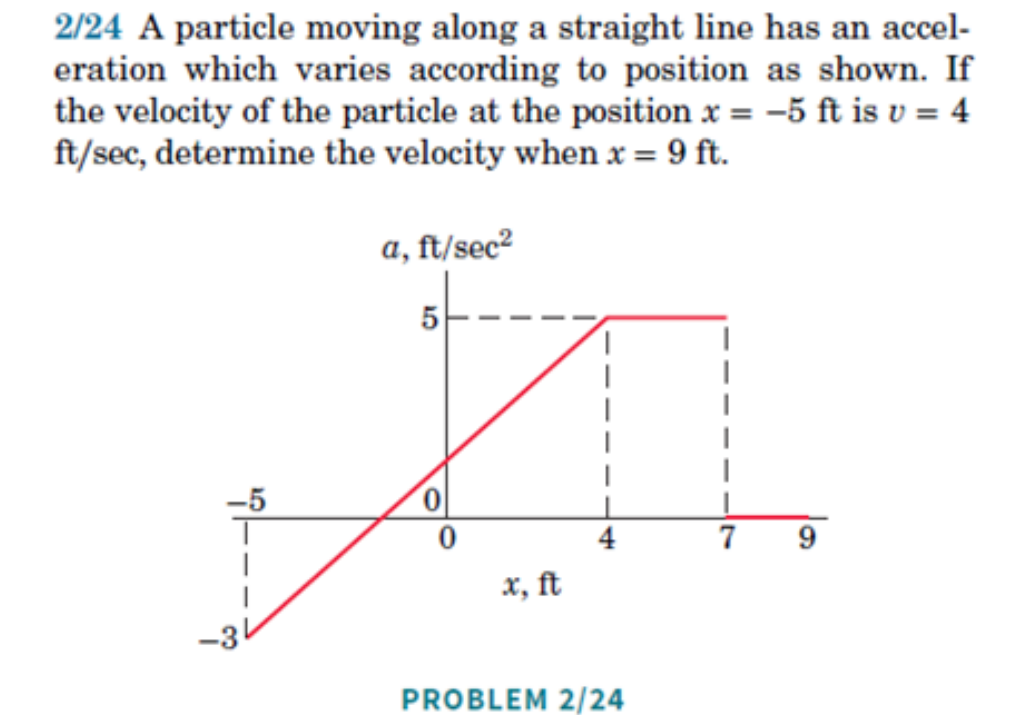
1. [MKB 2/24] Solve \(a(x)\) as a piecewise function. (ans. \(v = 8\) ft/sec)
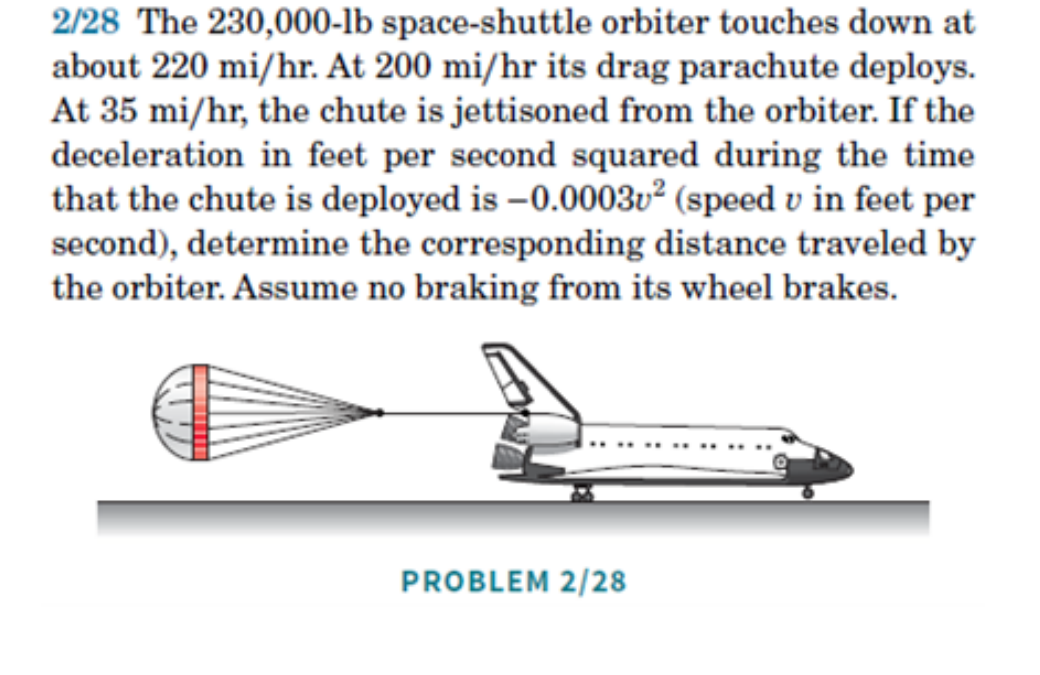
2. [MKB 2/28] Take \(\mathbf{E}_x\) along the horizontal; origin at the location of the plane when the parachute deploys (\(v=200\) mi/hr). Convert mi to ft and hr to sec. (ans. \(s = 5810\) ft)
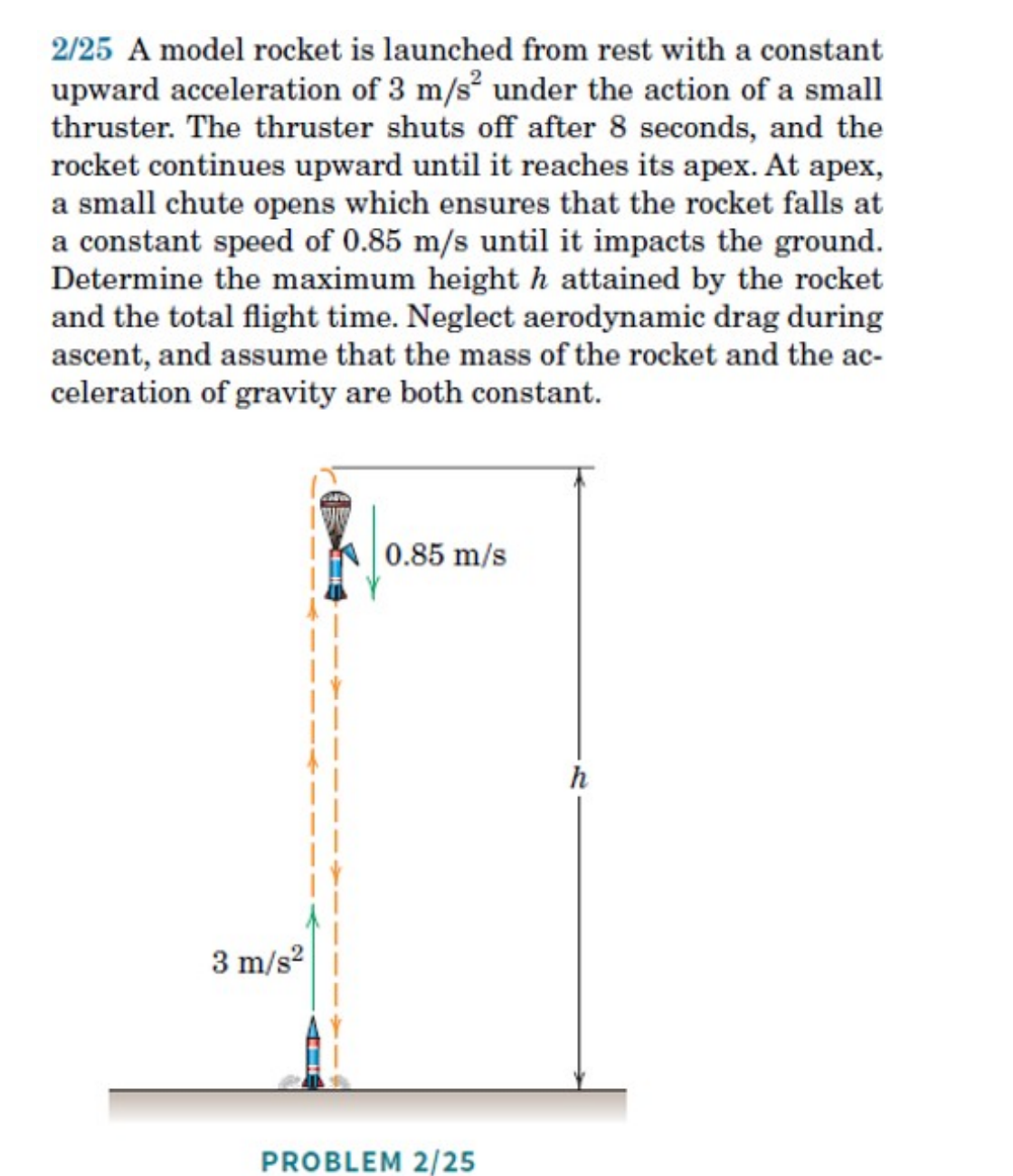
3. [MKB 2/25] Take \(\mathbf{E}_y\) vertically upwards; origin at the initial position of the rocket. The acceleration is \[\begin{align} a = \begin{cases} 3 \text{ m/s}^2 & 0\le t < 8\,\text{s} \\ -9.81 \text{ m/s}^2 & 8\,\text{s}\le t < t_{\mathrm{top}} \\ 0 & t_{\mathrm{top}} < t \le t_{\mathrm{end}} \end{cases} \end{align}\] (ans. \(h = 125.4\) m, total time \(= 157.9\) s)
4. [MKB 2/22]