11 The Serret-Frenet Basis
In general, the path of a particle is a curve in space — we refer to such curves as space curves.
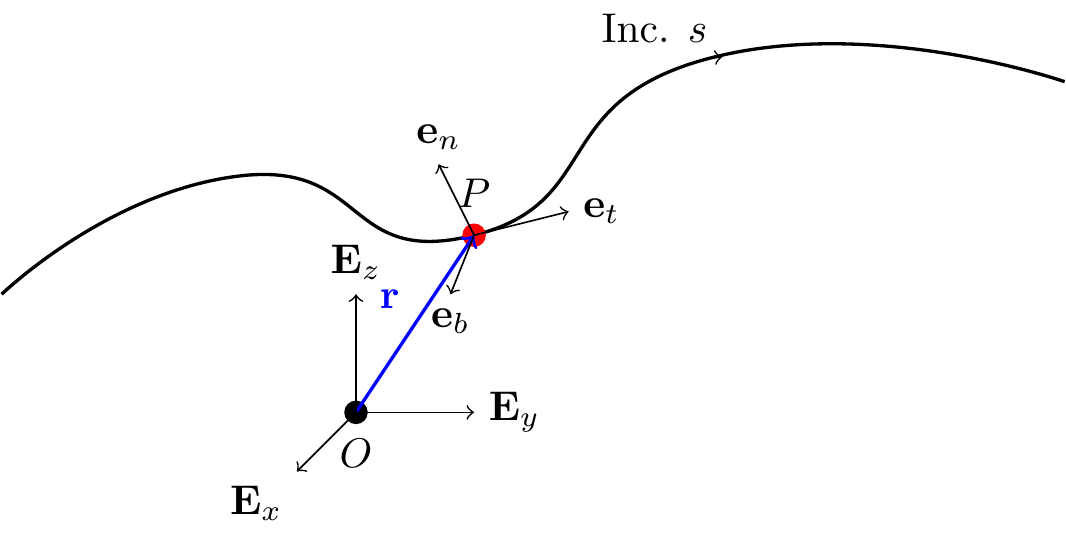
Consider a fixed curve \(\mathcal{C}\) embedded in \(\mathbb{E}^3\). Let the position vector of a point \(P\in\mathcal{C}\) be \({\bf r}\). In Cartesian coordinates, \({\bf r} = x{\bf E}_x+y{\bf E}_y+z{\bf E}_z\).
Recall the arc-length parameter \(s\) associated with \(\mathcal{C}\): \[\begin{align*} \lp\frac{ds}{dt}\rp^2 = \frac{d{\bf r}}{dt}\cdot\frac{d{\bf r}}{dt} = \frac{dx}{dt}\frac{dx}{dt}+\frac{dy}{dt}\frac{dy}{dt}+\frac{dz}{dt}\frac{dz}{dt}. \end{align*}\] This parameter uniquely identifies a point \(P\) on \(\mathcal{C}\), giving the representation \({\bf r} = \hat{\bf r}(s)\).
Historical Perspective: Frenet, Serret, and the Moving Basis
The unit vectors \({\bf e}_t, {\bf e}_n, {\bf e}_b\) carry the names of two French mathematicians who never worked together. Jean Frédéric Frenet first derived the formulas describing how this triad turns along a curve in his 1847 doctoral thesis at Toulouse, publishing only a summary in 1852. Joseph Alfred Serret arrived at the same relations independently and published them in full in 1851, and it is largely through his more widely circulated version that both the formulas and the triad came to carry both names.
The real subtlety of this basis is that \(\{{\bf e}_t,{\bf e}_n,{\bf e}_b\}\) rotates as the particle moves along \(\mathcal{C}\), even though the curve itself is fixed in space. Differentiating a vector expressed in a rotating basis introduces extra terms beyond the plain derivatives of its components. We meet this same fact again, under its own name, as the Coriolis acceleration, when we turn to rotating frames in cylindrical polar coordinates.
11.1 The Serret-Frenet Triad
The Serret-Frenet basis \(\{{\bf e}_t,{\bf e}_n,{\bf e}_b\}\) is defined at the point \(P\); it depends on the curve and the particle’s location on it.
TipThink!
Question: How do we define the unit tangent vector?
NoteAnswer
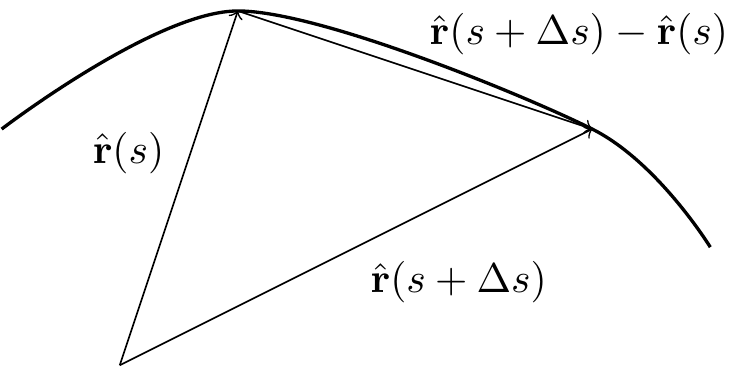
Recall the unit tangent vector: \[\begin{align} {\bf e}_t = \hat{\bf e}_t(s) = \frac{d{\bf r}}{ds} = \lim_{\Delta s\rightarrow 0}\frac{\hat{\bf r}(s+\Delta s)-\hat{\bf r}(s)}{\Delta s}. \end{align}\]
The hat (\(\hat{.}\)) indicates that this function is now expressed in terms of another variable, \(s\). \({\bf e}_t\) is known as the unit tangent vector to \(\mathcal{C}\) at the point \(P\).
For general motion, \(||\Delta{\bf r}||\neq ds\) except in the infinitesimal sense: \(\hat{\bf r}(s+\Delta s)-\hat{\bf r}(s) \rightarrow \Delta s{\bf e}_t\) as \(\Delta s\rightarrow 0\) and \(d{\bf r}\) is tangent to the curve.
We need to determine the expression for the acceleration in the Serret-Frenet basis. \[\begin{align} {\bf a} = \dot{\bf v} = \dot{v}{\bf e}_t+v\dot{\bf e}_t \end{align}\] where \[\begin{align} \dot{\bf e}_t = \frac{d\hat{\bf e}_t}{ds}\frac{ds}{dt} = v\frac{d{\bf e}_t}{ds}. \end{align}\] The derivative \(\frac{d\hat{\bf e}_t}{ds}\) only depends on the curve that the particle is tracing.
TipThink!
Question: What do we know about the direction of \(\frac{d\hat{\bf e}_t}{ds}\)?
NoteAnswer
We can show that \({\bf e}_t\) and \(\frac{d\hat{\bf e}_t}{ds}\) are perpendicular by differentiating \({\bf e}_t\cdot{\bf e}_t = 1\): \[\begin{align} \frac{d}{ds}\lp{\bf e}_t\cdot{\bf e}_t \rp = {\bf e}_t\cdot\frac{d{\bf e}_t}{ds} = 0. \end{align}\]
TipThink!
Question: What do we know about the magnitude of \(\frac{d\hat{\bf e}_t}{ds}\)?
NoteAnswer
Consider two curves. Draw the unit tangent vectors at the same distance along the curve, \(ds\), apart and draw their difference, \(\Delta {\bf e}_t\).
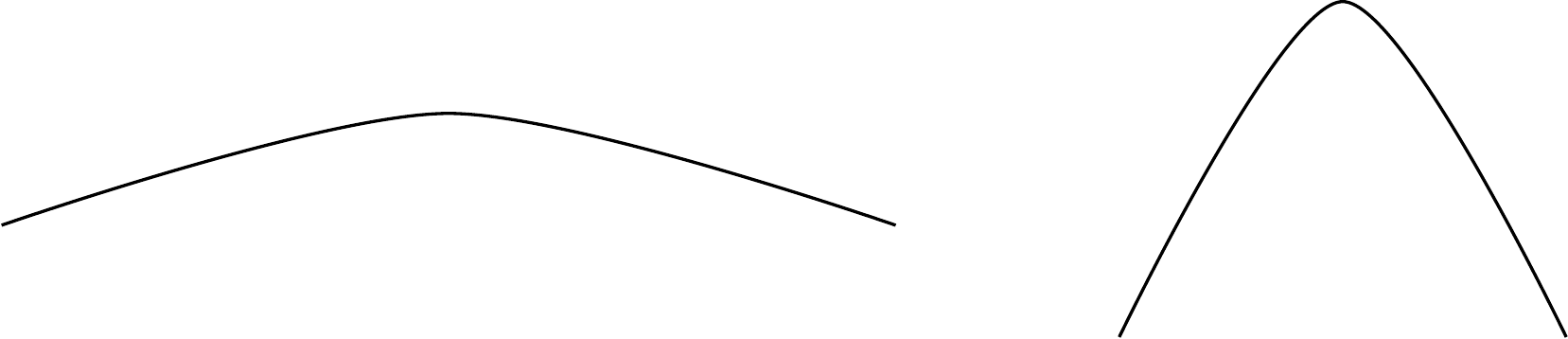
For which of these two curves is the magnitude of \(\frac{\Delta \hat{\bf e}_t}{\Delta s}\) higher?
As the curve begins to resemble a line, the magnitude of \(\frac{d\hat{\bf e}_t}{ds}\) becomes smaller. As the curvature of a curve increases, so does the magnitude of \(\frac{d\hat{\bf e}_t}{ds}\).
ImportantNote! Derivatives of a unit vector
It is a common mistake to assume that the derivative of a unit vector is necessarily a unit vector. Recall: \(\dot{\bf e}_r = \dot{\theta}{\bf e}_\theta\) is not generally a unit vector.
Hence, we define: \[\begin{align} \kappa{\bf e}_n = \frac{d{\bf e}_t}{ds}, \end{align}\] where \(\kappa = \lnorm \frac{d{\bf e}_t}{ds}\rnorm \geq 0\) and \(\lnorm{\bf e}_n\rnorm=1\).
- \({\bf e}_n\) is the unit principal normal vector.
- \(\kappa\) is the curvature of \(\mathcal{C}\) at \(P\).
- The radius of curvature is \(\rho = 1/\kappa\).
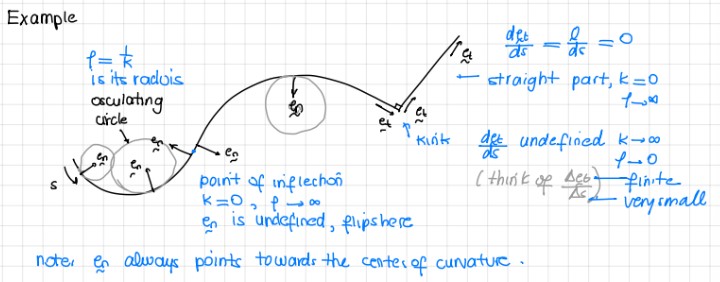
For any point on a curve, three nearby non-collinear points define the osculating circle (radius \(\rho\), center of curvature).
TipThink!
Question: When is \({\bf e}_n\) not uniquely defined?
NoteAnswer
When \(d{\bf e}_t/ds = {\bf 0}\) (i.e. \(\kappa = 0\)), such as on a straight line, at an inflection point, or at a corner. In this case, \({\bf e}_n\) is defined as any unit vector perpendicular to \({\bf e}_t\).
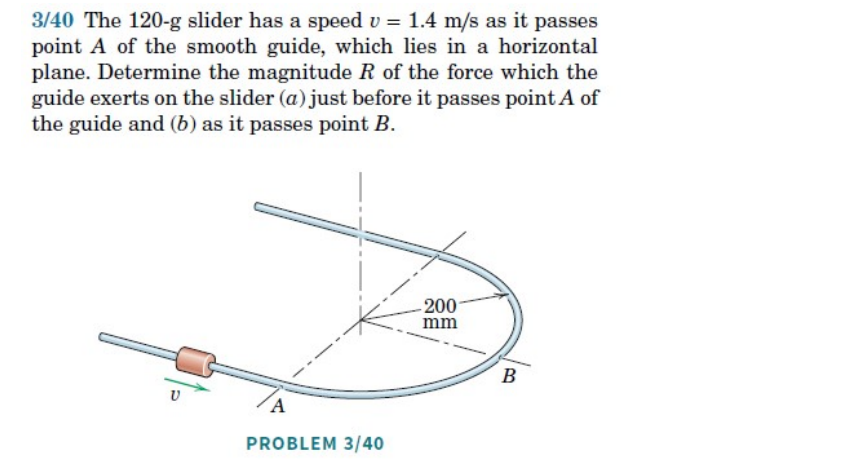
Example: In problem 03/040, we choose the Serret-Frenet basis on the straight portion of the curve to be such that it transitions smoothly to the curved portion of the curve.
The unit binormal vector: \[\begin{align*} {\bf e}_b = {\bf e}_t\times{\bf e}_n. \end{align*}\]
Concluding remarks:
- \(\{{\bf e}_t,{\bf e}_n,{\bf e}_b\}\) is orthonormal and right-handed.
- The osculating plane is spanned by \({\bf e}_t\) and \({\bf e}_n\); it contains the osculating circle.
- The rectifying plane is spanned by \({\bf e}_t\) and \({\bf e}_b\).
- The normal plane is spanned by \({\bf e}_n\) and \({\bf e}_b\).
A vector can be expressed in the Serret-Frenet basis as in any other basis. The Serret-Frenet basis is not a fixed basis. \[\begin{align} {\bf b} = b_t{\bf e}_t+b_n{\bf e}_n = b_x{\bf E}_x+b_y{\bf E}_y+b_z{\bf E}_z. \end{align}\]
Check out the following animation showing the osculating circle and video placing the Serret-Frenet basis on a bobsled.
11.2 Kinematics
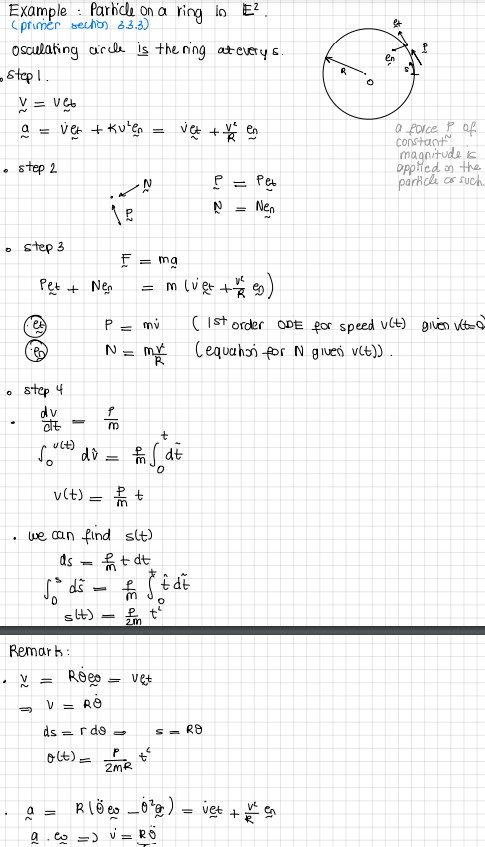
Position, velocity, and acceleration in the Serret-Frenet basis: \[\begin{align*} & {\bf r} = x{\bf E}_x+y{\bf E}_y+z{\bf E}_z = {\bf r}(t) = \hat{{\bf r}(s(t))}.\\ & {\bf v} = \dot{x}{\bf E}_x+\dot{y}{\bf E}_y+\dot{z}{\bf E}_z = \frac{d{\bf r}}{ds}\frac{ds}{dt} = \frac{ds}{dt}{\bf e}_t = v{\bf e}_t.\\ & {\bf a} = \dot{\bf v} = \frac{d}{dt}\lp\frac{ds}{dt}{\bf e}_t\rp = \frac{d^2}{dt^2}{\bf e}_t+\frac{ds}{dt}\frac{d{\bf e}_s}{ds} = \frac{d^2}{dt^2}{\bf e}_t+\frac{ds}{dt}\frac{d{\bf e}_t}{ds}\frac{ds}{dt} = \dot{v}{\bf e}_t+\kappa v^2{\bf e}_n. \end{align*}\]
11.3 Kinetics
\[\begin{align} {\bf F} &= m{\bf a}\\ F_t{\bf e}_t+F_n{\bf e}_n+F_b{\bf e}_b &= m\lp\dot{v}{\bf e}_t+\kappa v^2{\bf e}_n\rp. \end{align}\] Note that forces in the binormal direction should always balance.
11.3.1 Example: Problem 03/040 and Roller Coaster Design
TipThink!
Question: Consider the design of a roller coaster that is a circular ring. Comment on its safety.
NoteAnswer
At the transition between the circular and straight portions, there is a jump in curvature, hence a jump in acceleration, hence a jump in the normal force — producing a jerk. For a circular loop, the normal force goes from 0 to a finite value instantaneously. This could snap the rider’s neck. Instead, we use two connected clothoids (Euler spirals), whose curvature is proportional to arc length.
11.4 The Serret-Frenet Formulae
We want the derivatives of the Serret-Frenet basis vectors with respect to \(s\).
We already have: \[\begin{align} \frac{d{\bf e}_t}{ds} = \kappa{\bf e}_n. \end{align}\]
Since \({\bf e}_b\cdot{\bf e}_b = 1\), we have \(\frac{d{\bf e}_b}{ds}\cdot{\bf e}_b = 0\).
Also from \({\bf e}_t\cdot{\bf e}_b = 0\), we get \(\frac{d{\bf e}_b}{ds}\cdot{\bf e}_t=0\). So \(\frac{d{\bf e}_b}{ds}\) is parallel to \({\bf e}_n\): \[\begin{align} & {\bf e}_t\cdot{\bf e}_b = 0\\ & \frac{d{\bf e}_t}{ds}\cdot{\bf e}_b+\frac{d{\bf e}_b}{ds}\cdot{\bf e}_t = 0\\ & \kappa{\bf e}_n\cdot{\bf e}_b+\frac{d{\bf e}_b}{ds}\cdot{\bf e}_t = 0\\ & \frac{d{\bf e}_b}{ds}\cdot{\bf e}_t=0. \end{align}\] Consequently, we define \[\begin{align} \frac{d{\bf e}_b}{ds} = -\tau{\bf e}_n, \end{align}\] where \(\tau\) is the torsion of \(\mathcal{C}\) at \(P\). The negative sign in the above formula is a convention.
Then: \[\begin{align} \frac{d{\bf e}_n}{ds} &= \frac{d}{ds}\lp{\bf e}_b\times{\bf e}_t\rp\\ &= \frac{d{\bf e}_b}{ds}\times{\bf e}_t+{\bf e}_b\times\frac{d{\bf e}_t}{ds}\\ &= (-\tau{\bf e}_n)\times{\bf e}_t+{\bf e}_b\times\kappa{\bf e}_n\\ &= -\kappa{\bf e}_t+\tau{\bf e}_b. \end{align}\]
In summary (the Serret-Frenet formulae): \[\begin{align} \begin{bmatrix} \frac{d{\bf e}_t}{ds}\\ \frac{d{\bf e}_n}{ds}\\ \frac{d{\bf e}_b}{ds} \end{bmatrix} = \begin{bmatrix} 0 & \kappa & 0\\ -\kappa & 0 & \tau\\ 0 & -\tau & 0 \end{bmatrix} \begin{bmatrix} {\bf e}_t\\ {\bf e}_n\\ {\bf e}_b \end{bmatrix}. \end{align}\]
Define the Darboux vector \(\bomega_{SF} = \kappa{\bf e}_b+\tau{\bf e}_t\) so that: \[\begin{align} \frac{d{\bf e}_i}{ds} = \bomega_{SF}\times{\bf e}_i, \quad i = t, n, b. \end{align}\]
11.4.1 Example: A Particle on a Helix
For a helix \(x=R\cos(\theta)\), \(y=R\sin(\theta)\), \(z=\alpha R\theta\): \[\begin{align} {\bf r} = R{\bf e}_r+\alpha R\theta{\bf E}_z = x{\bf E}_x+y{\bf E}_y+z{\bf E}_z. \end{align}\] \[\begin{align} \kappa = \frac{1}{R(1+\alpha^2)}, \qquad \tau = \frac{\alpha}{(1+\alpha^2)R}. \end{align}\]
11.5 The Curvature Formula for a Plane Curve
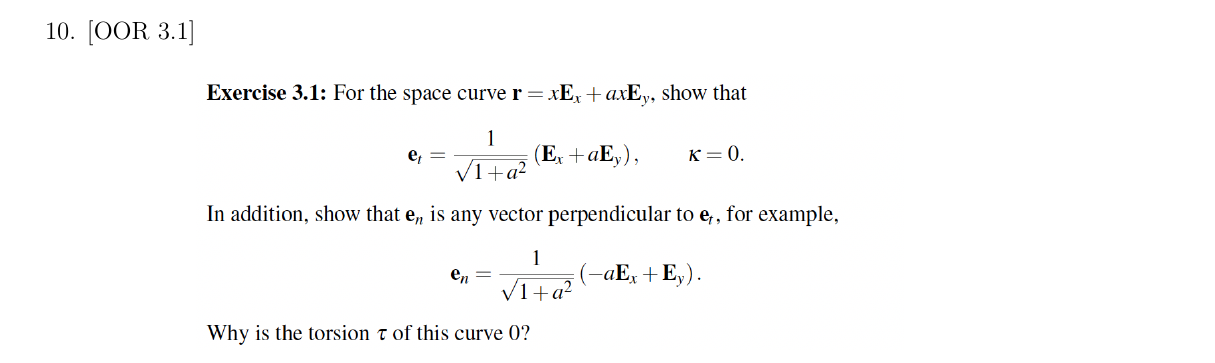
Consider a point \(P\) tracing a plane curve with \(y = f(x)\), \(z = z_0\), so that \[\begin{align} {\bf r} = x{\bf E}_x+f(x){\bf E}_y+z_0{\bf E}_z. \end{align}\]
Determining the arc-length parameter \(s\): \[\begin{align} \begin{split} & \frac{d{\bf r}}{dt} = \frac{dx}{dt}{\bf E}_x+\frac{df}{dx}\frac{dx}{dt}{\bf E}_y,\\ & \lp\frac{ds}{dt}\rp^2 = \lp 1+\lp\frac{df}{dx}\rp^2\rp\lp\frac{dx}{dt}\rp^2,\\ & \frac{ds}{dt} = \frac{dx}{dt}\sqrt{1+\lp\frac{df}{dx}\rp^2},\\ & s = s(x) = \int_{x_0}^x\sqrt{1+\lp\frac{df}{du}\rp^2}\,du+s(x_0). \end{split} \end{align}\]
The tangent vector: \[\begin{align} {\bf e}_t = \frac{d{\bf r}}{ds} = \frac{d{\bf r}}{dx}\frac{dx}{ds} = \frac{1}{\sqrt{1+\lp\frac{df}{dx}\rp^2}}\lp{\bf E}_x+\frac{df}{dx}{\bf E}_y\rp. \end{align}\]
The \(\kappa{\bf e}_n\) expression: \[\begin{align} \kappa{\bf e}_n = \frac{d{\bf e}_t}{ds} = \frac{d{\bf e}_t}{dx}\frac{dx}{ds} = \frac{\frac{d^2 f}{dx^2}}{\lp1+\lp \frac{df}{dx}\rp^2\rp^2}\lp{\bf E}_y-\frac{df}{dx}{\bf E}_x\rp. \end{align}\]
Recalling that \({\bf e}_n\) is a unit vector and \(\kappa \geq 0\): \[\begin{align} \begin{split} & \kappa = \kappa(x) = \frac{\left|\frac{d^2 f}{dx^2}\right|}{\lp\sqrt{1+\lp\frac{df}{dx}\rp^2}\rp^3},\\ & {\bf e}_n = \frac{\text{sgn}\lp\frac{d^2 f}{dx^2}\rp}{\sqrt{1+\lp\frac{df}{dx}\rp^2}}\lp{\bf E}_y-\frac{df}{dx}{\bf E}_x\rp, \end{split} \end{align}\] where \(\text{sgn}(a)=1\) if \(a>0\) and \(-1\) if \(a<0\).
The binormal vector and torsion: \[\begin{align} {\bf e}_b = {\bf e}_t\times{\bf e}_n = \text{sgn}\lp\frac{d^2 f}{dx^2}\rp{\bf E}_z, \end{align}\] and because this vector is piecewise constant, the torsion of the plane curve is \(\tau = 0\).
11.6 Alternative Notation for Plane Curves
This section is not usually covered.
For plane curves, some texts define the angle \(\beta = \beta(s)\) such that: \[\begin{align} {\bf e}_t = \cos(\beta){\bf E}_x+\sin(\beta){\bf E}_y, \qquad \bar{\bf e}_n = \cos(\beta){\bf E}_y-\sin(\beta){\bf E}_x. \end{align}\] Then \(\kappa = \left|\frac{d\beta}{ds}\right|\) and \(\frac{d\beta}{ds}\) is the rate of rotation of the triad about \({\bf E}_z\).
11.7 Summary
Serret–Frenet basis \(\{\mathbf{e}_t,\mathbf{e}_n,\mathbf{e}_b\}\): \[\begin{align} \mathbf{v} &= v\,\mathbf{e}_t, \qquad \mathbf{a} = \dot v\,\mathbf{e}_t + \kappa v^2\,\mathbf{e}_n, \qquad \mathbf{e}_b = \mathbf{e}_t\times\mathbf{e}_n. \end{align}\] The curvature is \(\kappa=1/\rho\) (radius of curvature \(\rho\)). The BoLM gives \(F_t = m\dot v\) and \(F_n = m\kappa v^2\).
11.8 Exercises
The following problems are from Set 07 – The Serret–Frenet Basis.
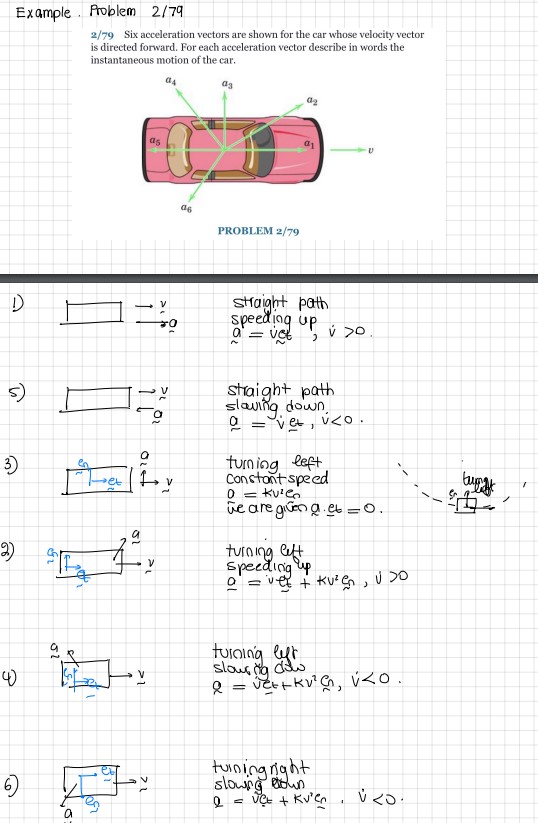
1. [MKB 2/079] Analyse the acceleration vector in the Serret–Frenet basis.
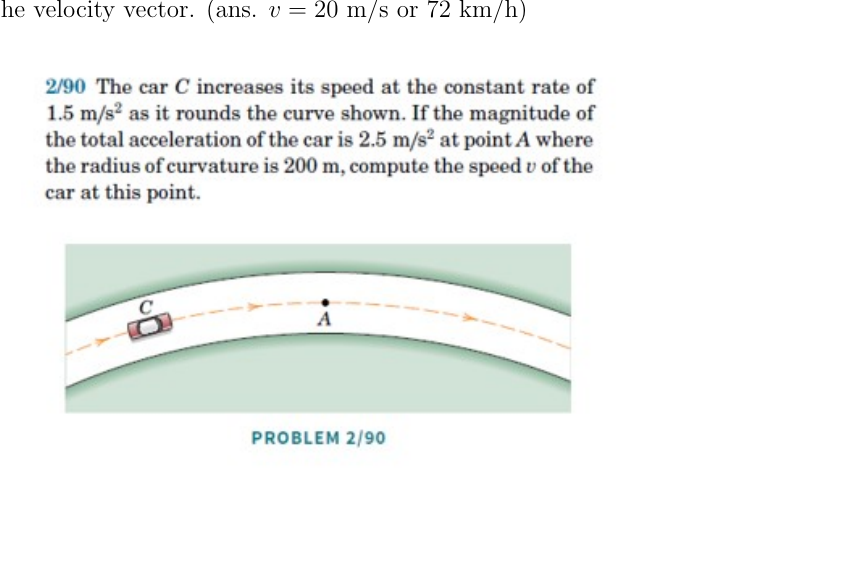
2. [MKB 02-090] Note that \(\dot v \neq \|\mathbf{a}\|\); acceleration has both tangential and normal components. (ans. \(v = 20\) m/s)
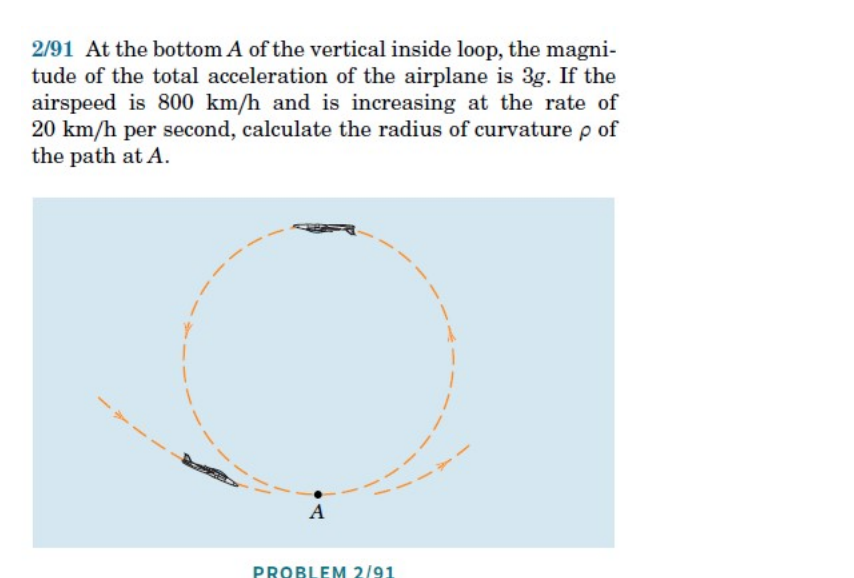
3. [MKB 02-091] (ans. \(\rho = 1709\) m)
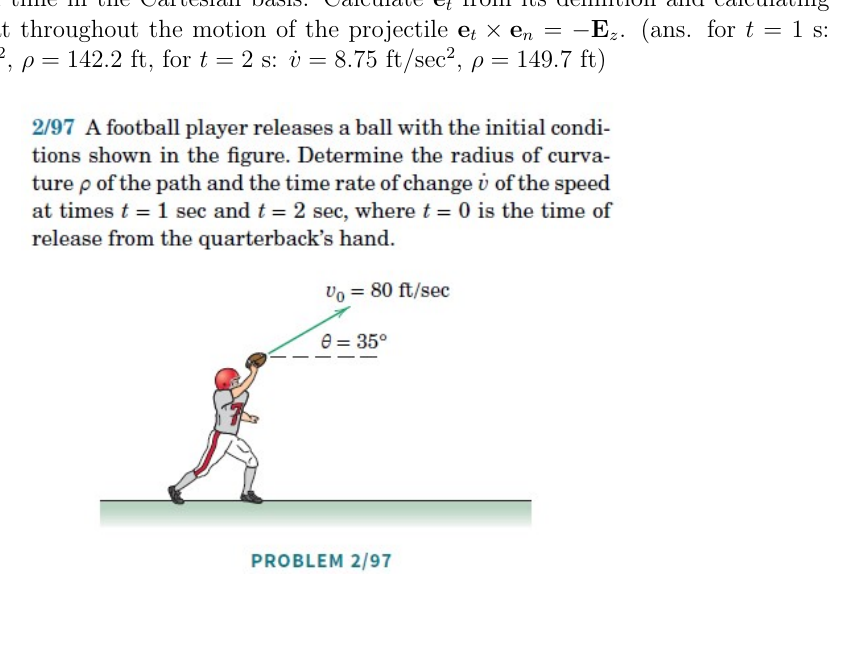
4. [02-097] Follow the 4 steps; express \(\mathbf{e}_t\) and \(\mathbf{e}_n\) in the Cartesian basis. (ans. at \(t=1\) s: \(\dot v=-6.58\) ft/s\(^2\), \(\rho=142.2\) ft; at \(t=2\) s: \(\dot v=8.75\) ft/s\(^2\), \(\rho=149.7\) ft)
5. [02-103] (ans. \((x_C,y_C)=(22.5,-22.9)\) m)
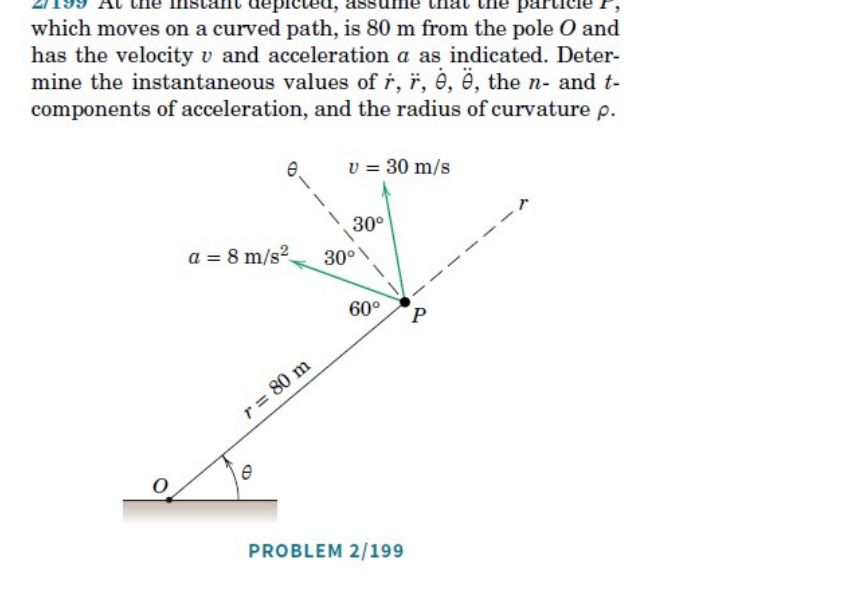
6. [02-199] Draw \(\mathbf{e}_t\) and \(\mathbf{e}_n\) first. (ans. \(\dot r=15\) m/s, \(\dot\theta=0.325\) rad/s, \(\rho=129.9\) m)
7. [03-040] Note the jump in normal force at the transition from straight to curved path. (ans. (a) \(R=1.177\) N; (b) \(R=1.664\) N)
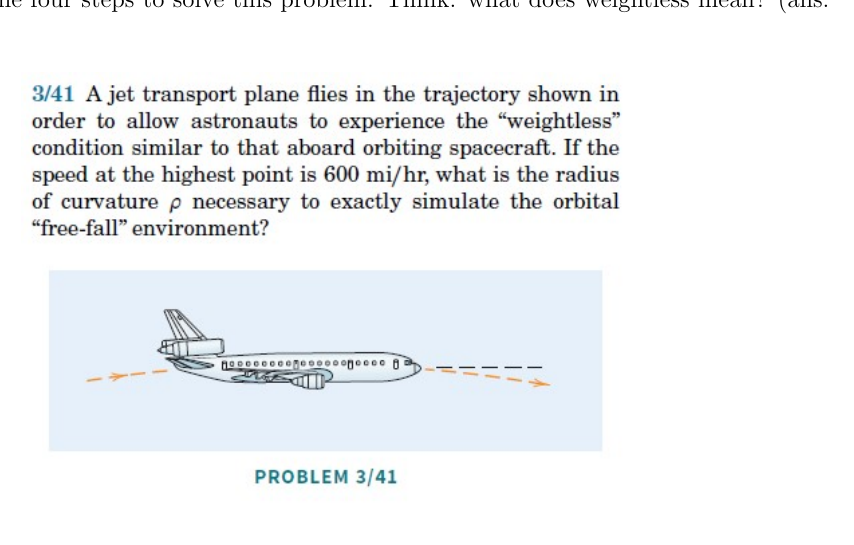
8. [03-041] What does “weightless” mean? (ans. \(\rho=24\,000\) ft)
9. [03-043] Draw the Serret–Frenet basis carefully; the figure hints at the direction of \(\mathbf{e}_n\). (ans. \(v=29.1\) m/s, \(N=12.36\) kN)
10. [OOR 3.1]
11. [OOR 3.2]