10 Constrained Motion
The degree of freedom (DOF) of a system is the number of independent coordinates needed to describe a configuration of the system.
Examples:
| System | DOFs | Constraints | Constraint equation(s) |
|---|---|---|---|
| A particle free to move in \(\mathbb{E}^2\) | 2 | 0 | – |
| A particle constrained to move on a curve in \(\mathbb{E}^2\) | 1 | 1 | (curve equation, implicit) |
| Two particles free to move in \(\mathbb{E}^2\) | 4 | 0 | – |
| Two particles in \(\mathbb{E}^2\) constrained to move on the same curve | 2 | 2 | (curve equation for each particle, implicit) |
| Two particles in \(\mathbb{E}^2\) connected by a rigid rod | 3 | 1 | \(\lnorm{\bf r}_{B/A}\rnorm = l\,\forall t\) |
| Two particles in \(\mathbb{E}^2\) connected by a rigid rod and constrained to move on a curve | 1 | 3 | \(\lnorm{\bf r}_{B/A}\rnorm = l\,\forall t\); curve equation for each particle (implicit) |
The number of constraints is the number of DOFs the unconstrained system would have (2 per free particle in \(\mathbb{E}^2\)) minus the actual number of DOFs; each independent constraint equation removes exactly one DOF.
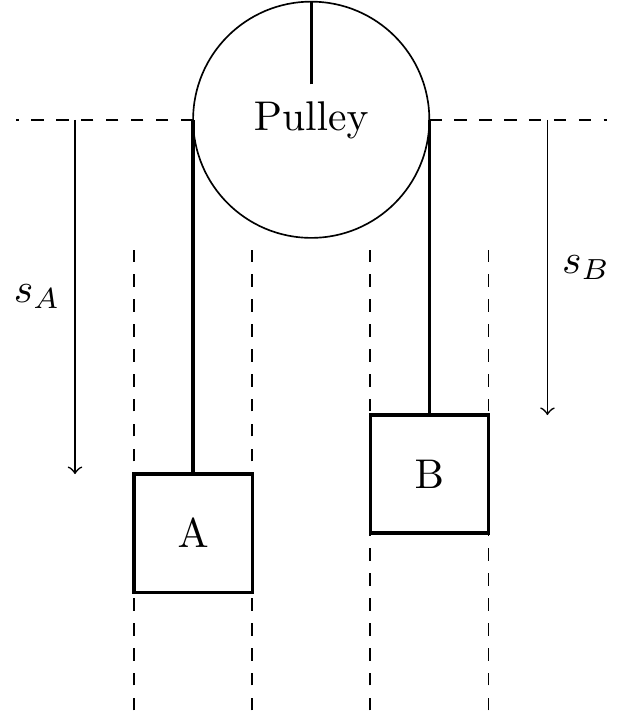
Example: Consider two particles in smooth vertical slots. If \(A\) and \(B\) move independently, the system has 2 DOFs. If connected by an inextensible cable, the system has 1 DOF.
The inextensibility constraint \(\ell = \text{const.}\) can be written as: \[\begin{align} & \ell = s_A+c+s_B\\ & \Delta \ell = 0 = \Delta_{t_1\rightarrow t_2} s_A+\Delta_{t_1\rightarrow t_2} s_B\\ & \implies \Delta s_B = -\Delta s_A\\ & \dot{\ell} = 0 = \dot{s}_A+\dot{s}_B\\ & \implies \dot{s}_B=-\dot{s}_A. \end{align}\]
10.1 Summary
For pulley–chord systems: (1) choose a datum, (2) define distances from the datum, (3) write a chord equation per chord. Each chord equation and its derivatives give additional constraints.
10.2 Exercises
The following problems are from Set 06 – Constrained Motion.
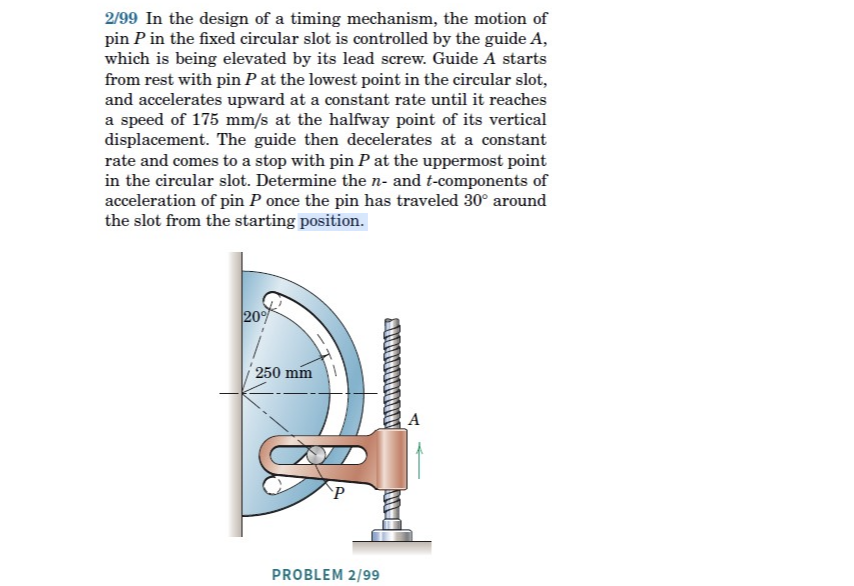
1. [MKB 2/099] Determine the \(\mathbf{e}_r\) and \(\mathbf{e}_\theta\) components of the acceleration of pin \(P\); origin at the centre of the circular slot. (ans. \(a_n = 66.0\) mm/s\(^2\), \(a_t = 29.7\) mm/s\(^2\))
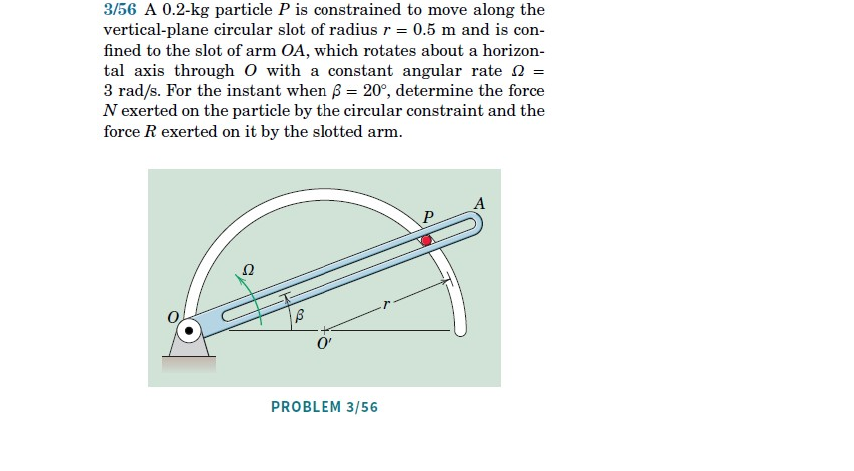
2. [03-056] Set up two polar coordinate systems with origins \(O\) and \(O'\). Write position vectors of \(P\) in each basis. (ans. \(N = 2.89\) N towards \(O'\), \(R = 1.599\) N)
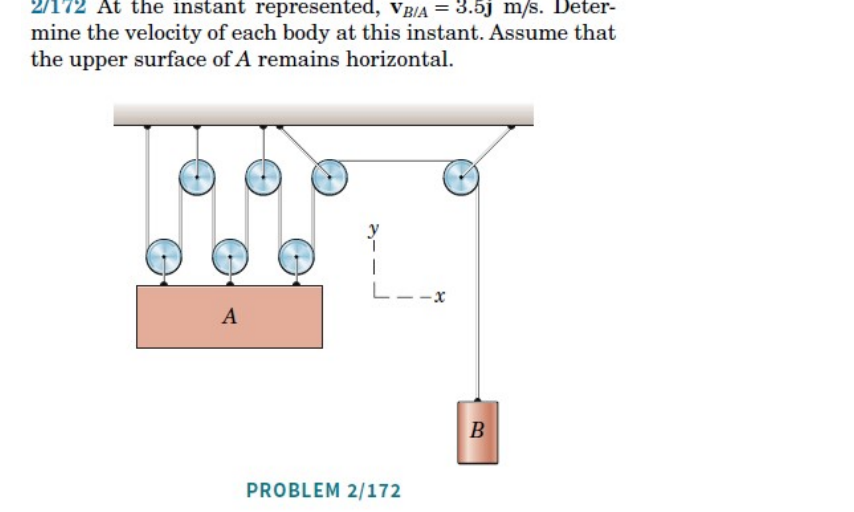
3. [MKB 02-172] Use \(\mathbf{v}_{B/A}=\mathbf{v}_B-\mathbf{v}_A=3.5\mathbf{E}_y\) m/s. (ans. \(\mathbf{v}_A=-0.5\mathbf{E}_y\) m/s, \(\mathbf{v}_B=3\mathbf{E}_y\) m/s)
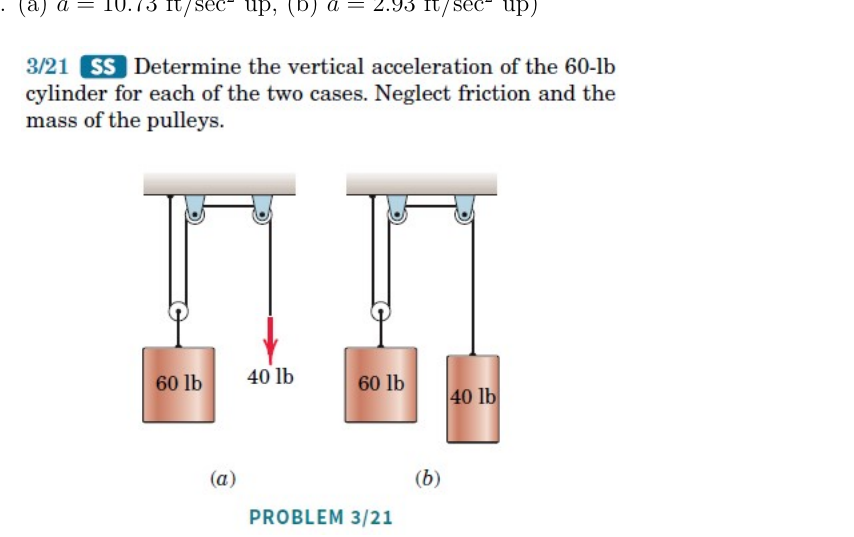
4. [MKB 03-021] Draw FBDs of the massless pulleys to find forces on the 60-lb cylinders. (ans. (a) \(a=10.73\) ft/sec\(^2\) up; (b) \(a=2.93\) ft/sec\(^2\) up)
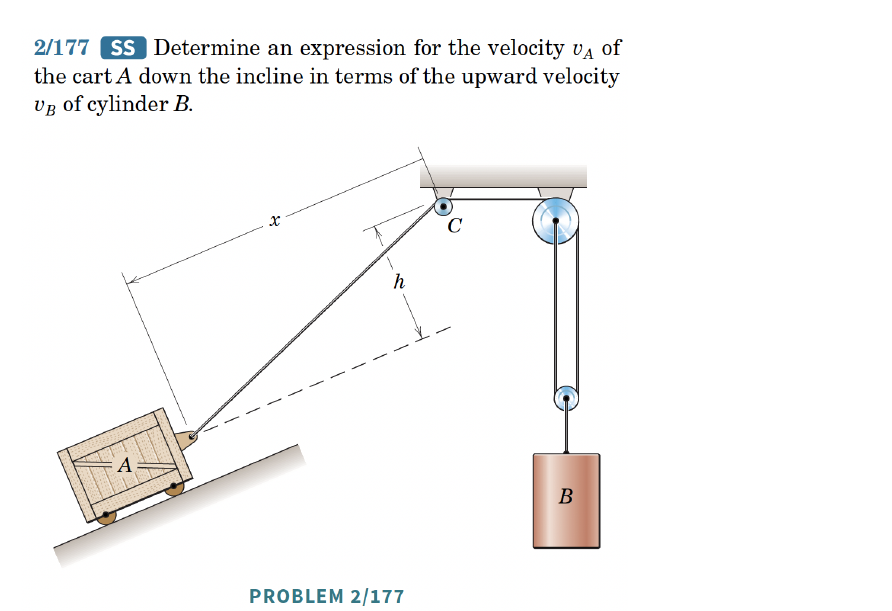
5. [MKB 2-177]
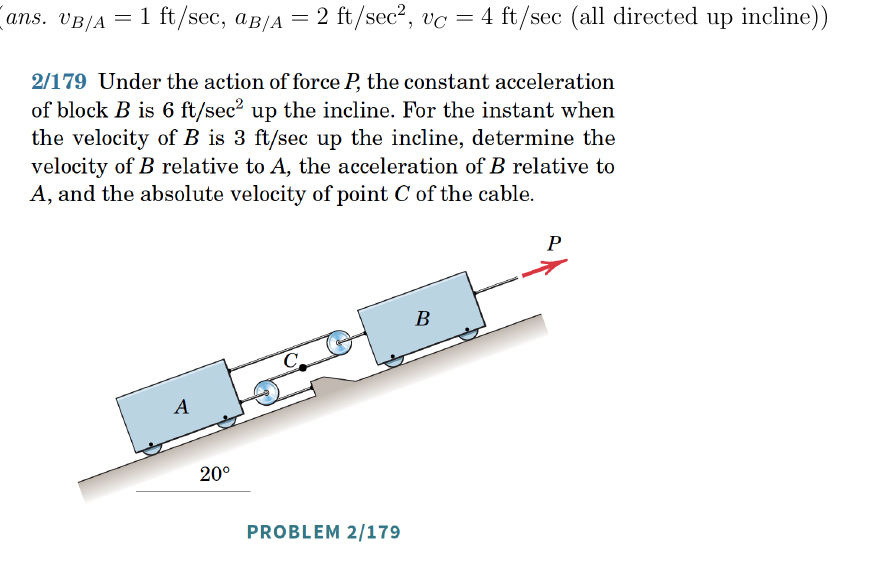
6. [MKB 2-179]