22 Systems of Particles and Rigid Bodies
The balance laws developed separately for particles, systems of particles, and rigid bodies apply just as well to combinations of these — assemblies of rigid bodies and particles connected by pins, rods, or motors. The following example illustrates how to set up such a problem: identifying the kinematic constraints between the bodies, drawing free-body diagrams of the combined system and of its parts, and applying the balance laws to each.
22.1 Example: BB8
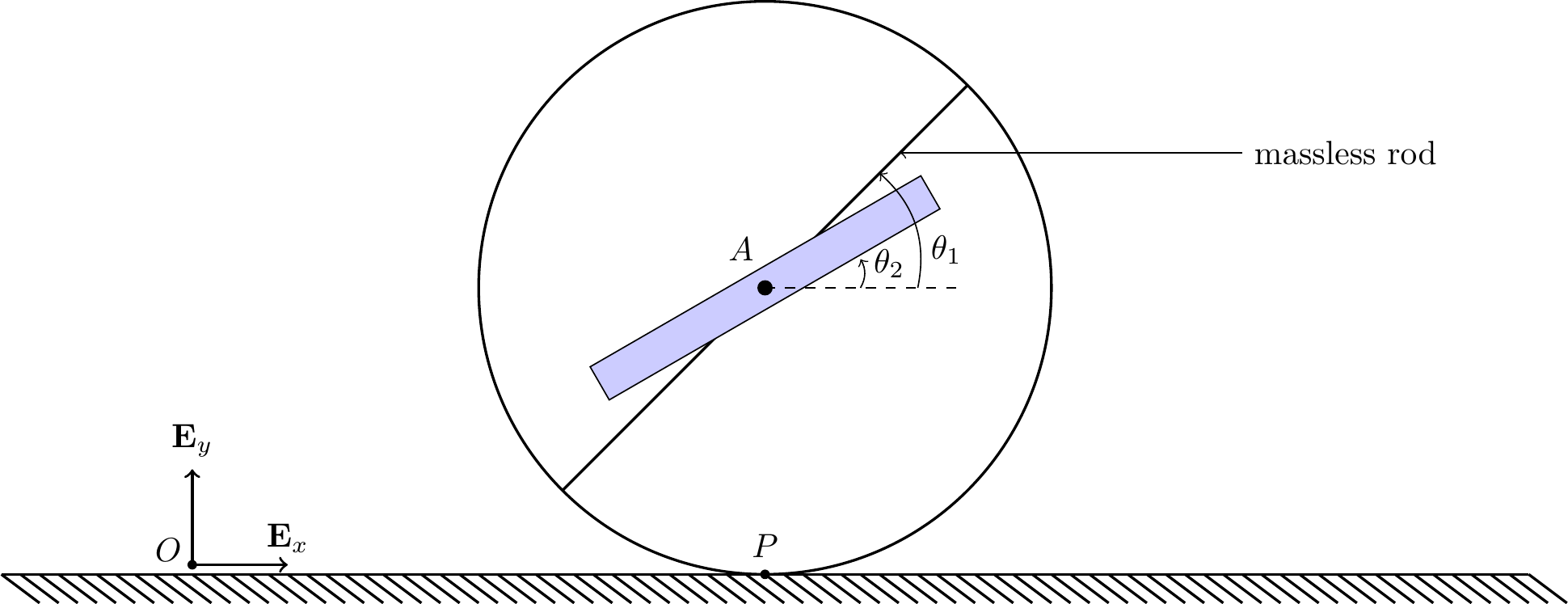
Consider a spherical robot composed of a spherical shell of mass \(m\) and radius \(R\) and a bar of mass \(2m\) and length \(\ell<2R\) pinned at point \(A\), its center, to the center of the shell as shown in the figure below. A geared motor drive at \(A\) provides an internal moment which rotates the bar. The friction between the robot and the ground is sufficient to prevent slipping.
Throughout the motion, the position vector from the origin to the center of the robot is \({\bf r}_A = x{\bf E}_x+R{\bf E}_y\).
The angular velocity of the spherical shell is \(\bomega_1 = \dot{\theta}_1{\bf E}_z\) and the angular velocity of the bar of length \(\ell\) is \(\bomega_2 = \dot{\theta}_2{\bf E}_z\).
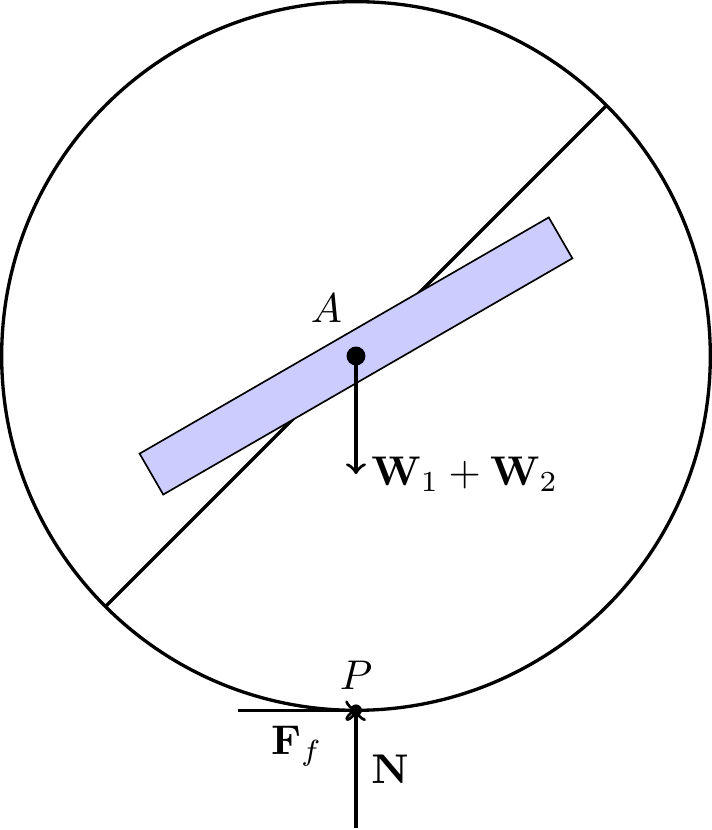
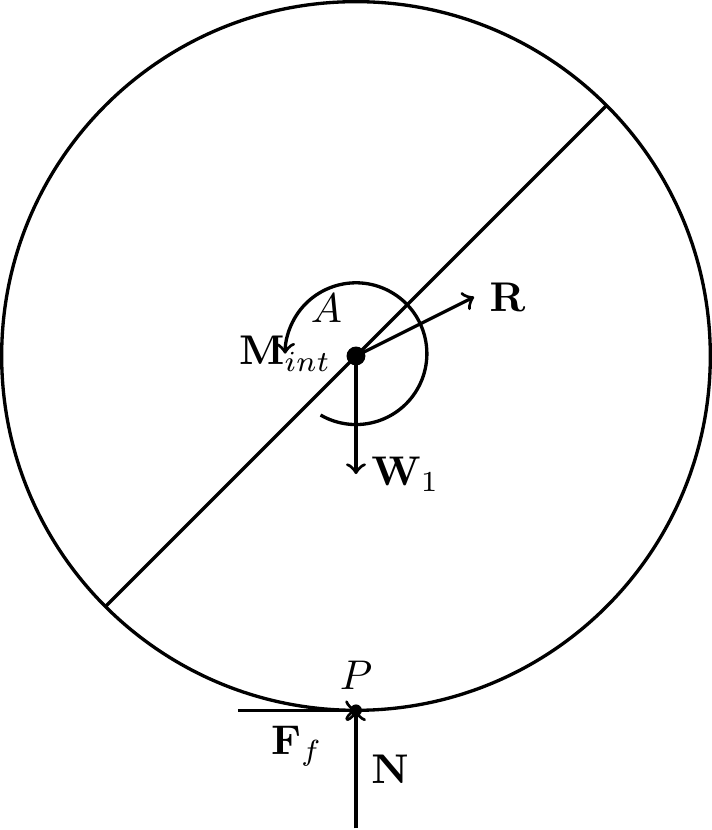
Draw the free-body diagram of (1) the combined system of the spherical shell and the bar of length \(\ell\), (2) the spherical shell with its massless diameter alone, and (3) the bar of length \(\ell\) alone.
We wish to determine the motion of the robot, i.e., we want to find \(x(t)\), \(\theta_1(t)\), \(\theta_2(t)\), resulting from the moments applied by the motor. How do we proceed?
22.1.1 Free-Body Diagrams
Combined system (shell + bar):
Spherical shell alone:
Bar alone:
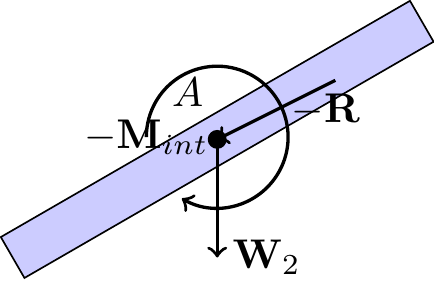
where \[\begin{align} {\bf F}_f = F_f{\bf E}_x. \end{align}\]
22.1.2 Kinematics
By differentiating \({\bf r}_A\), we get \[\begin{align} \begin{split} {\bf v}_A &= \dot{x}{\bf E}_x,\\ {\bf a}_A &= \ddot{x}{\bf E}_x. \end{split} \end{align}\]
The roll-without-slip condition between the sphere and the ground, \({\bf v}_P={\bf 0}\), yields a relationship between \(x\) and \(\theta_1\): \[\begin{align} \begin{split} {\bf v}_C &= \bomega_1\times R{\bf E}_y,\\ \dot{x} &= -R\dot{\theta}_1. \end{split} \end{align}\]
22.1.3 Balance of Linear Momentum (Combined System)
\[\begin{align} {\bf F} = (m_1+m_2){\bf a}_A. \end{align}\]
NoteNote
This example is left as a set-up exercise: complete the balance of linear momentum in components, then use the balance of angular momentum (about \(A\) or about \(P\)) for the combined system, the shell alone, and the bar alone, together with the kinematic constraint above, to solve for \(x(t)\), \(\theta_1(t)\), \(\theta_2(t)\).